"Companies are finally seeing that AI marketing content performs 58% worse in emotional resonance tests. The pendulum is swinging back. Smart marketers are positioning 'human-crafted' as a premium differentiator, like 'organic' in food."
That sentence comes from a marketer in Digiday's coverage of the 2025 reckoning. The frame she uses is doing all the work. Like organic in food. Most people read past that comma. The comma is the post.
There is a history we have lived through before. It is worth remembering, because it tells us what happens next.
The last time this happened — to food
In the 1950s and 60s, industrial agriculture won. Fertilizer, pesticides, factory livestock, frozen and processed everything. Food got cheap and abundant. The producers of food got rich. Consumers got more calories for less money than any generation had ever seen.
For thirty years, that arrangement held. There was no counter-market. The few hold-outs who kept farming the old way looked quaint, marginal, sentimental. They sold at farmers' markets to small audiences. They had no economic logic on their side.
Then the audience changed. People noticed they could taste the difference. Slowly, a counter-market formed. Whole Foods opened. Organic became a regulated certification with a USDA seal. By 2010, organic was a $30B industry growing at three times the rate of conventional food.
The audience had not stopped eating. They had started caring where their food came from. They were willing to pay more — sometimes much more — for the version of food that had a person standing behind it.
The premium appeared even though organic food was not, in measurable ways, nutritionally superior. That debate continues. Audiences were buying the origin. The process. The integrity. The care.
What is happening to content now
The same pattern is appearing in the market for creative work.
For three years, the AI side of content has been the cheap, abundant, industrial side. Volumes exploded. Costs collapsed. Marketing teams, publishers, and clients who used to pay for human work moved budgets to AI tools and AI-managed pipelines. The economic logic was overwhelming.
For three years, there was no counter-market. The freelancers who kept working the old way looked quaint, sentimental, marginal. They sold to a shrinking audience of clients who had not yet noticed they could do the same work for less.
Then audiences started to notice. Engagement on AI campaigns curdled. Brand sentiment scores dropped. A Stanford analysis put a number on the gap — machine-generated text scores 58% lower in emotional resonance than human work. The audience was telling the market something the market had not asked.
"Content uniformity has become the new normal, leaving audiences craving fresh perspectives. Smart writers are using this data to justify premium rates."
That is a content writer naming the swing. The cheap option is everywhere. The audience is fatigued. A counter-market is forming.
The shape is identical to organic food in 1985. The premium is appearing for the same reason.
Renata, on the morning she changed her invoice
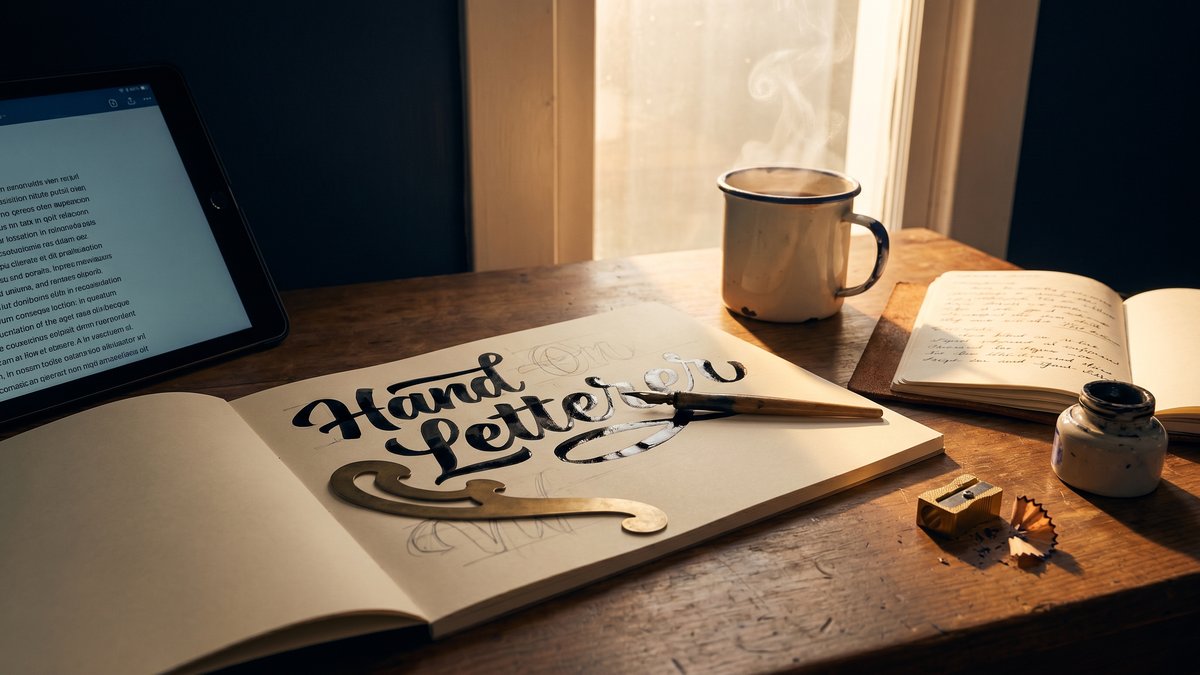
Renata is a hand-letterer and custom type designer in Lisbon. She spent twelve years building a freelance practice for boutique brands — wine labels, hotel signage, restaurant menus, the lettering on the front of a coffee shop that does not exist anywhere else.
Her work was always the kind that took time. A custom logotype was a six-week engagement. A full type system for a small brand was four months. Her clients paid a premium because the alternative was buying a font, and her clients had decided that buying a font was not what their brand stood for.
By mid-2024, she was getting fewer of those calls. Midjourney and other image models had reached the point where a brand could generate plausible lettering in twenty minutes. New clients were asking her to "supervise" AI generations instead of draw from scratch. Her quote-to-close ratio collapsed.
She tried adapting. She licensed an AI tool. She offered "AI-assisted" packages at half her usual rate. The lower price did not bring more clients. It brought clients who wanted AI-assisted prices and AI-assisted speeds, both. The quality of the work she shipped slid. So did her sense of what she was selling.
Then she did something small that changed the trajectory. She added two words to her invoices and to the page on her website that listed her services.
Hand-crafted lettering.
Not hand-drawn, which had been on the site for years and was being read as descriptive rather than positional. Hand-crafted, with the bridging echo of handcrafted in design language and artisan in food language and bespoke in fashion language. The phrase did the positioning that her old descriptions did not.
The first three discovery calls after the change were different. The conversations did not start with budget. They started with the question she had not been asked in eighteen months. Do you still draw it yourself, from scratch?
Two of the three closed. Her project rates were back to her 2023 levels by the end of the quarter. By June, her pipeline was full again, with a slightly different client mix and a higher floor.
What "human-crafted" is doing in the market
The phrase is positional, not a quality claim. Most people miss the distinction and the phrase fails for them.
A quality claim says my work is better than the alternative. The audience has to evaluate the claim. Most audiences cannot. The claim collapses into marketing noise.
A positional claim says my work is on a different shelf from the alternative. The audience does not have to evaluate. They just have to know which shelf they want to be on.
Organic is a positional claim. The shopper buying organic carrots is not running a nutrient comparison. The shopper is choosing a shelf — the shelf where a person stood behind the work and a process was followed.
Human-crafted is a positional claim too. The marketer hiring a human-crafted copywriter is not running an A/B test. The marketer is choosing a shelf — the shelf where a person stood behind the choice and the choice can be defended in a board meeting.
The shelf has economic value because the alternative shelf — AI-generated, mass-produced, indistinguishable in volume from every competitor — has stopped working for a meaningful slice of the audience.
Why this is not Luddism
The cleanup niche we wrote about last week is one half of the breakthrough. Human-crafted is the other half.
Cleanup specialists fix what AI got wrong. Human-crafted specialists position themselves where AI is not allowed to compete. The two are complements. Both depend on the same underlying market correction.
Neither is a refusal of AI. The most successful human-crafted practitioners in our research use AI tools daily for research, brainstorming, draft variations, version control. The difference is what they sign their name to. The final output, the choice of direction, the surfaces the client buys — those are explicitly hand-crafted. The AI is in the workshop, not on the invoice.
The shape mirrors organic food precisely. An organic farm uses modern equipment. It uses computers, tractors, modern irrigation. What it does not use is the specific industrial inputs the certification excludes. The organic label is a defined boundary around the parts of the process the customer is paying for — never a wholesale refusal of progress.
The work of repositioning
Human-crafted is easy to say and hard to do. Three things stand in the way.
The first is that you have to mean it. Audiences and clients can feel a positional claim that is not backed by work. If your human-crafted illustration is sixty percent AI generation with a hand-drawn signature, the market will discover it and the premium will collapse faster than it built. The position requires real labor in the loop.
The second is that you have to be specific. Human-crafted on its own is a soft claim. Specific enough to defend is the lettering is drawn from scratch in pencil before any digital work begins or the strategy memo is built from a hundred original interviews per quarter, not from a model trained on someone else's work. The audience does not just want the label. They want to know what the label rules out.
The third is that you have to raise your rates. The premium is the point. A human-crafted practice priced at AI-assisted rates will starve. The underpricing will also train your audience to read your positioning as marketing, not substance.
"Smart writers are using this data to justify premium rates."
That is the Stanford-citing content writer again, naming the move. The data exists. The audience demand exists. The positional shelf exists. The willingness to charge the premium is what almost every freelancer in the bind has to find on the other side of being broke and afraid.
Why this is hard alone
Most freelancers we read in the breakthrough cluster did not get to human-crafted by themselves. Repositioning is not an information problem. It is a perception problem. You cannot reposition something you cannot see clearly.
Renata had been doing hand-crafted lettering for twelve years. The label was always available to her. She did not use it because she was inside the trade, where the term felt redundant. Every letterer hand-draws. The phrase was meaningless from the inside. It was only meaningful at the boundary — to the marketing director who does not know letterers and is comparing her to a Midjourney prompt.
The boundary is not visible from inside the trade. It takes a conversation with someone who is not in the trade. Or a peer who has already crossed it. Or a coach whose job is to ask questions until the obvious becomes visible again.
This is where Ariel, Haven AI's voice-based coach, was designed to sit. Not to give you the positioning sentence. To ask the questions that surface what is already true about your work but has gone invisible to you because you have been doing it for years.
What part of your work happens in your hands and not in any tool? What do clients pay you for without naming? What would the marketing language be if you were selling on a different shelf?
What comes next
We are early in the human-crafted swing. The audience is forming. The certifications and labels are not standardized yet. The premium is appearing in pockets — Creative practices in some cities, content studios in some niches, agencies that have started writing human-led into their proposals.
The certifications will come. They always do. Organic started as a vibe in farmers' markets in the 1970s and was a federal regulation by 1990. Hand-crafted will follow a faster curve because the internet compresses these cycles.
The freelancers who position early get the brand value of being first. The ones who wait until the labels are formal will pay for the premium with someone else's brand attached to their work.
If your craft was the thing that made you legible before AI flooded the market, the position is open. The market is ready to pay for it. The work is in naming what you do clearly enough for the audience to find the right shelf.
That naming, like all of the work in the bind, is hard to do alone.
In Haven AI's research across 8,300+ freelancer quotes, the human-crafted repositioning is the most consistent breakthrough pattern in Creative, Marketing, and Content. Audiences are paying a premium for human origin. The work is naming yours in language the audience can find.