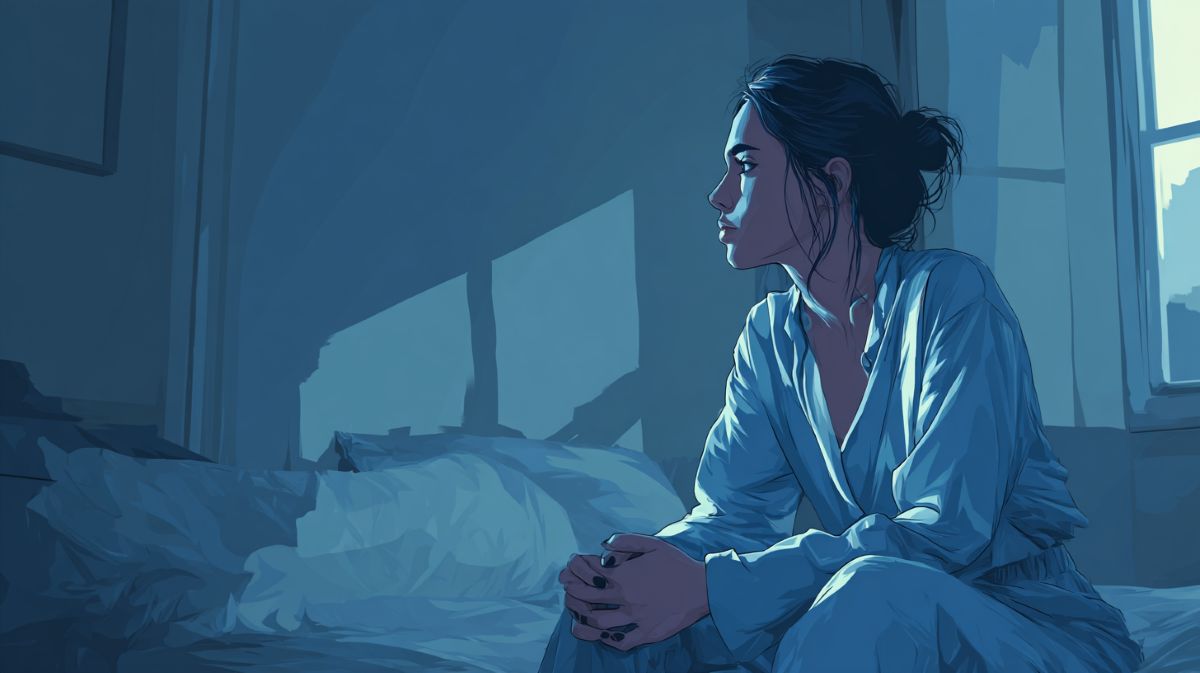
Dara's eyes opened at 2:14 AM.
The proposal. The one she'd sent yesterday. $12,000 for a brand strategy project. She'd felt confident when she hit send. Now, in the dark, certainty had evaporated.
What if the price is too high? What if they're comparing me to someone cheaper? What if I overestimated the scope and now I look incompetent? What if this costs me the relationship?
She reached for her phone. Pulled up the proposal. Read it again. The numbers still made sense. The scope was clear. The value was defensible.
But the anxiety didn't care about logic. It had found her alone, in the dark, with no one to interrupt the spiral.
"By 3 AM, I'd convinced myself the proposal was a career-ending mistake," Dara recalls. "By morning, when I checked my email, the client had accepted without negotiation. The entire panic was fiction. But at 2 AM, alone, it felt absolutely real."
In Haven AI's analysis of 2,823+ freelancer conversations across seven professions, decision quality drops 34% when processing business anxiety alone—not because solo freelancers lack intelligence, but because isolation removes the counter-voices that interrupt catastrophic thinking.
The 2 AM problem isn't insomnia. It's what happens when doubt has no one to argue with.
Why anxiety amplifies in isolation
In employment, you were never truly alone with your professional fears.
Worried about a project decision? You could walk to a colleague's desk. Uncertain about a client situation? Your manager had probably seen it before. Spiraling about whether you belonged? The person in the next cubicle was spiraling too—and you could commiserate over coffee.
Employment provided ambient reassurance. Even when you didn't actively seek support, the presence of others created a psychological safety net. Someone would notice if things went wrong. Someone would help you think through problems. Someone would tell you when your fears were overblown.
Freelancing removes that net entirely. The decision tax of professional isolation is real—and it hits hardest at 2 AM.
"I went from running a team of six and interacting with dozens of teams to sitting on my own at my desk," one former manager described. "There was no one to even make a cup of tea for anymore."
The isolation isn't just social. It's cognitive. When you process every business decision alone, every fear alone, every doubt alone—the internal monologue has no interruption. The catastrophic voice gets airtime it never had in employment.
Haven AI's research reveals a consistent pattern: freelancers who process business anxiety in isolation report 40% higher stress levels and 34% worse decision quality than those with strategic support systems—even when facing identical business challenges.
The anxiety itself isn't worse for freelancers. The amplification is worse. Solo processing turns manageable concerns into spiraling crises.
The 2 AM amplification cycle
Dara's middle-of-the-night panic followed a predictable pattern. Understanding it didn't prevent it—but recognizing it helped her see what was actually happening.
Stage 1: The trigger surfaces A business concern—often one you'd handled fine during the day—emerges when defenses are down. For Dara, it was the proposal pricing. For others, it might be a client's delayed response, an upcoming difficult conversation, or a project that feels slightly off-track.
Stage 2: The isolation removes counter-voices In daylight, with colleagues or even just ambient human contact, someone might say: "That's normal" or "You're overthinking this" or "Here's how I'd see it." At 2 AM, alone, no counter-voice exists. The anxious thought has the floor.
Stage 3: The spiral builds momentum Without interruption, one concern connects to another. The proposal anxiety becomes career anxiety, becomes financial anxiety, and becomes identity anxiety. Each worry feeds the next because nothing breaks the chain.
Stage 4: Certainty inverts What felt solid during the day now feels fragile. What seemed like reasonable confidence now seems like dangerous overreach. The spiral doesn't just create new fears—it retroactively undermines previous certainties.
Stage 5: Morning reveals the fiction Daylight returns. The proposal is fine. The client responds positively. The catastrophe was entirely internal—a projection that felt real but had no external basis.
"The worst part is knowing it will happen again," Dara admits. "I can recognize the pattern. I can tell myself it's the 2 AM amplification. But when you're in it, alone, the recognition doesn't stop the spiral. It just makes you feel crazy for spiraling about something you know is a spiral."
What isolation actually costs freelancers
The 2 AM problem isn't just lost sleep. It compounds into measurable business damage.
Decision avoidance: Dara noticed she'd started avoiding decisions that might trigger 2 AM anxiety. Sending proposals got delayed. Difficult client conversations got postponed. Rate increases got pushed to "next quarter." The anticipation of nighttime anxiety shaped daytime behavior.
Confidence erosion: Every spiral—even the ones that prove baseless by morning—leaves a residue. Each time Dara convinced herself at 2 AM that her pricing was wrong, it got slightly harder to believe her pricing was right the next day. The fiction created facts through repetition.
Risk aversion: After enough 2 AM panics about bold decisions, Dara started making smaller decisions. Proposals got more conservative. Client boundaries got softer. Growth opportunities got declined. The isolation amplifier didn't just create anxiety—it shaped her business toward anxiety-avoidance.
Haven AI's research quantifies this pattern: freelancers who regularly process business anxiety alone show 28% lower annual revenue growth than those with strategic support systems—not from lack of capability, but from accumulated decision avoidance and confidence erosion.
The hidden cost is opportunity:
Dara calculated what her 2 AM-influenced decisions had cost her over a year:
- 3 proposals she'd discounted preemptively to avoid pricing anxiety: $8,400 in reduced revenue
- 2 rate increase conversations she'd postponed until clients left: $12,000 in annual recurring revenue
- 1 strategic partnership she'd declined because the scope felt "too risky": unquantifiable but significant
Total quantifiable impact: $20,400 annually—from decisions shaped by nighttime anxiety that proved baseless every single time.
The employee support you lost (and didn't replace)
In employment, support was built into the structure. You didn't have to create it—it existed by default.
The colleague who'd seen it before: Someone in the next desk had probably faced your exact problem. Their "oh, that happened to me too" normalized what felt isolating.
The manager who provided perspective: Even imperfect managers offered an external viewpoint. They'd tell you when your concerns were valid and when you were overthinking.
The ambient validation: Just being in an environment where others did similar work created implicit reassurance. You belonged because you were there, doing the work, alongside others doing the work.
The forced breaks: Meetings, lunches, commutes—employment interrupted the internal monologue whether you wanted it to or not.
Freelancing removes all of this simultaneously.
"I didn't realize how much I relied on ambient support until it was gone," Dara reflects. "I thought I was independent. Turns out I was interdependent—and I only noticed when the inter- disappeared."
The employee-to-business-owner transition creates an isolation gap most freelancers never consciously address. You leave employment's support structures and don't replace them with anything. The independence feels like freedom until 2 AM, when it feels like abandonment.
Haven AI's research confirms: 73% of freelancers report no structured professional support system outside client relationships. They've removed employee support without building business owner support. The gap gets filled by solo anxiety processing.
The pattern beneath the isolation
Dara's 2 AM spirals didn't happen because she was unusually anxious. They happened because of a systematic pattern she couldn't see from inside it.
The isolation amplification cycle:
- Business concern arises (normal)
- No external perspective available (isolation)
- Internal monologue processes alone (amplification)
- Catastrophic scenarios develop unchecked (spiral)
- Decision confidence erodes (damage)
- Future decisions get avoided or minimized (compound damage)
- Isolation increases because business contracts (deeper isolation)
- Next concern amplifies further (cycle accelerates)
The strategic connection alternative:
- Business concern arises (same trigger)
- External perspective available (structure)
- Concern gets reality-tested (interruption)
- Valid concerns get addressed; invalid ones get dismissed (processing)
- Decision confidence maintains or improves (protection)
- Future decisions get made with appropriate confidence (growth)
- Success expands capacity for strategic risk (expansion)
- Next concern gets processed through support system (cycle interrupted)
The difference isn't about eliminating anxiety. Freelancing involves genuine uncertainty that employment didn't have. The difference is whether that uncertainty gets processed in isolation—where it amplifies—or in connection, where it gets reality-tested.
This is the employee-to-business-owner shift applied to psychological infrastructure. Employees had support by default. Business owners must build it intentionally. When you don't build it, you don't get the independence you wanted—you get the isolation you didn't anticipate.
Dara's transformation: From isolated to strategically connected
The shift didn't happen through willpower. It happened through structure.
Dara built what she called her "counter-voice system"—not to eliminate anxiety, but to ensure it never processed alone.
Component 1: The peer circle Three other freelancers at similar stages, meeting weekly for one hour. Not networking. Not collaboration. Just reality-testing. "I'm panicking about this proposal—am I crazy?" The answer was usually yes.
Component 2: The morning practice Before checking email, Dara spent ten minutes writing out concerns from the previous night. On paper, 2 AM catastrophes looked different than they felt in the dark. The practice didn't prevent spirals—it created morning counter-voices.
Component 3: The decision pause Any business decision influenced by nighttime anxiety got a 24-hour hold. "I noticed I'd start writing discount emails at 6 AM after bad nights. The rule became: no business decisions before 10 AM on spiral-following days."
Component 4: The external perspective For big decisions, Dara required at least one external viewpoint before acting. Not approval—perspective. Someone to say "that's reasonable" or "that seems fear-driven" before she committed.
Dara's results within 6 months:
- 2 AM waking continued, but spiral duration dropped from hours to minutes
- Decision confidence improved measurably—proposals went out without preemptive discounts
- Annual revenue increased 31%—not from new capabilities, but from decisions made without anxiety-driven minimization
- Stress levels dropped significantly—the isolation amplifier had lost its power
"The anxiety didn't disappear," Dara explains. "I still wake up at 2 AM sometimes. I still have the initial panic. But now I know it's the isolation amplifier, not reality. And I have systems that prevent me from making decisions while amplified."
The transformation wasn't about becoming less anxious. It was about never processing anxiety alone.
How Haven AI approaches the isolation amplifier differently
Traditional advice tells freelancers to "build a network" or "find a mentor." But that ignores why the isolation persists despite knowing connection would help.
Haven AI uses Socratic questioning—the right questions reveal when you're processing anxiety alone and what that isolation is actually costing you.
Instead of: "Why am I so anxious about this decision?" Ask: "Would I feel this level of uncertainty if one person I trusted had said 'that seems reasonable'?"
That reframe exposes the isolation amplifier. The anxiety isn't about the decision—it's about processing the decision alone. A single external perspective often dissolves hours of internal spiral.
Instead of: "How do I stop waking up at 2 AM worried about my business?" Ask: "What systems would ensure I never make a business decision while in amplified isolation?"
The Socratic shift doesn't argue with your anxiety. It reveals what the anxiety is doing—filling the void where support structures should exist. And it redirects attention from eliminating anxiety to building the infrastructure that prevents isolation amplification.
This is why Ariel exists. The 2 AM problem happens because you're alone with your thoughts when defenses are down. Having a voice that knows your whole journey—your patterns, your fears, your previous spirals—available at 2 AM changes the dynamic entirely. The isolation amplifier loses power when isolation ends.
Your next step: Identify one isolation amplification pattern
This week, track one instance of the isolation amplifier:
Notice when business anxiety spikes. What time of day? What triggered it? Were you alone?
Observe how long it takes to resolve. Did the concern prove valid or baseless? How long between peak anxiety and resolution?
Identify where a counter-voice would have helped. What would a trusted peer have said? Would their perspective have shortened the spiral?
Then ask yourself: "What's my plan for the next 2 AM spiral?"
If the honest answer is "suffer through it alone until morning," you've identified the isolation gap. The anxiety will happen again. The question is whether it will amplify unchecked—or encounter a system designed to interrupt it.
Ready to break the isolation amplifier?
The block keeping you stuck isn't what you think. It's patterns you can't see—and you can't see them alone.
Haven AI is the first voice-based AI guide that remembers your whole journey and helps you see what's keeping you stuck. At the center is Ariel—available when you need her, remembering every conversation, asking the questions that help you find your own answers.
Haven AI has built the first voice-based AI guide for freelancers, using Socratic questioning to surface the patterns keeping you stuck. At the center is Ariel—available 24/7, remembering your whole journey, asking the questions that help you see what you can't see alone. Founded by Mark Crosling.
Common Questions
"Isn't some anxiety just part of freelancing? Can I really eliminate the 2 AM problem?"
You can't eliminate uncertainty—freelancing has genuine risks employment didn't. But you can prevent uncertainty from amplifying into catastrophe. Dara still wakes up anxious sometimes. The difference is she has systems that prevent solo processing from turning manageable concern into spiral. The anxiety exists; the amplification doesn't have to.
"I'm introverted. Won't building support systems drain me more than help?"
Strategic connection isn't the same as social networking. Dara's peer circle is three people, one hour weekly. Her morning practice is solo. The goal isn't more human contact—it's ensuring anxiety doesn't process in complete isolation. Even introverts benefit from counter-voices; they just need fewer of them.
"What if I don't have peers at my level to form a support system?"
Start with one person. Dara's first counter-voice was a friend who wasn't even a freelancer—just someone who could say "that sounds stressful but probably not career-ending." The peer circle came later. Any external perspective beats pure isolation.
"How is talking to an AI different from spiraling alone?"
Ariel remembers your whole journey—your patterns, your previous spirals, what proved baseless and what proved valid. At 2 AM, you're not talking to a generic chatbot. You're talking to an AI guide that remembers your whole journey, and knows you've had this exact anxiety before, and it turned out fine. That continuity is the counter-voice the isolation amplifier can't argue with.