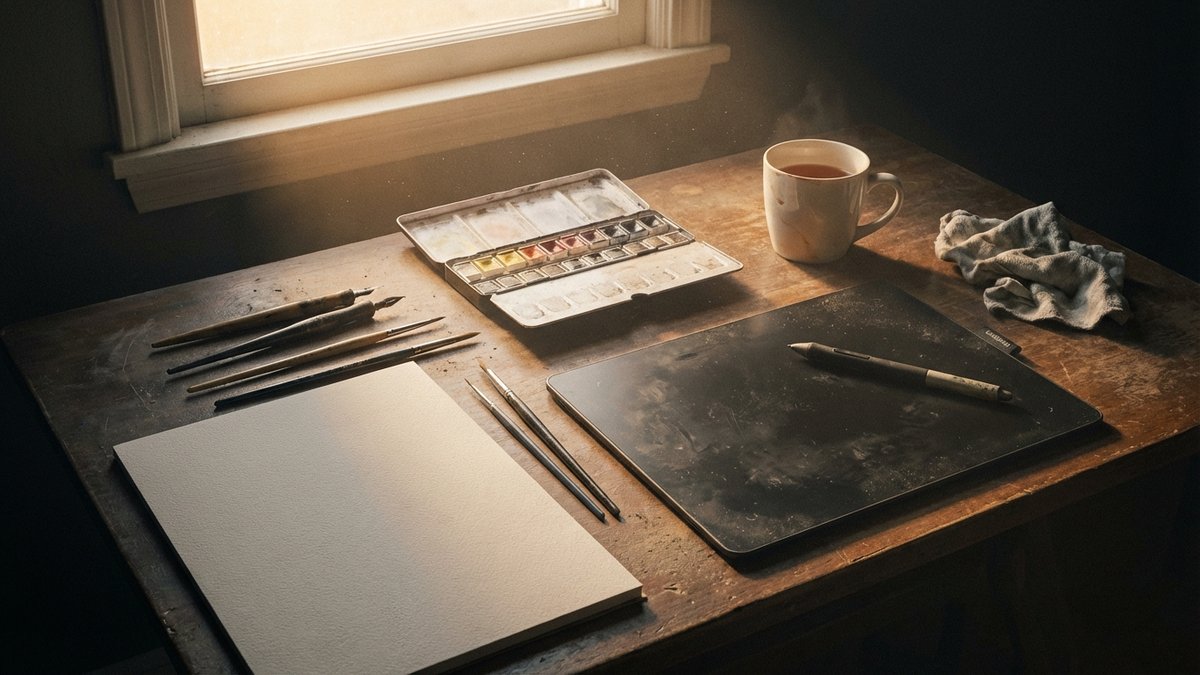
"Illustrator, as a job, does not exist anymore."
Let that sit for a moment. Not "illustrator is changing." Not "illustrator is evolving." Not "illustrator faces new challenges." Does not exist anymore. Past tense applied to a profession that, three years ago, employed hundreds of thousands of people who paid rent with it, built careers around it, organized their entire identities inside it.
Lena has been an illustrator for fourteen years. Children's books, editorial work, character design for indie games. She never got rich, but she built something real — a client list, a recognizable style, a body of work she could point to and say: this is what I do. This is what I am.
In 2022, she invoiced 68 assignments. In 2024, she invoiced 19.
The phone didn't taper off. It stopped.
The two-year timeline
In August 2022, three things happened almost simultaneously: Midjourney entered open beta, DALL-E 2 launched publicly, and Stable Diffusion went open source. For a few months, illustrators treated the output as a curiosity. Interesting, technically. Not a threat. The images had extra fingers. The compositions were incoherent. The aesthetics were derivative. It was a toy.
By mid-2023, the toy had eaten the bottom of the market.
"It seemed like overnight all those jobs disappeared."
The first wave was the work nobody romanticized: stock illustrations, social media graphics, pitch deck visuals, blog header images. Work that paid the bills between the meaningful projects. Work that illustrators relied on for cash flow even if they didn't build portfolios around it. That work vanished in months — not because AI was better, but because AI was free.
Then the middle of the market went.
"In 2020, I invoiced 77 assignments. So far this year, I've invoiced 22."
"My business turnover is down over 60% from last year."
"I just lost 15,000 euros to an AI agency."
That last one is the sentence that makes Lena's hands shake when she repeats it. An agency she'd worked with for three years — an agency that knew her style, had praised her work, had specifically requested her by name — replaced her with an AI service. Not gradually. Not after a trial period. One email. Fifteen thousand euros of annual work, gone.
"About half of the people I've worked alongside this last decade have left the field."
Half. In two years. Not retirements. Not career pivots made from positions of strength. An exodus of trained professionals who looked at the market and concluded that the thing they'd spent years becoming was no longer something the world would pay for.
What was stolen
The financial collapse is visible. The theft underneath it is harder to talk about, but it's what makes this story different from every previous industry disruption.
"His name used as AI prompt over 400,000 times since September 2022 without permission."
Four hundred thousand times. A working illustrator's style — the visual language he developed over decades, the thing that made his work recognizably his — scraped from the internet, fed into a training dataset, and reproduced on command by anyone with a text box and a subscription. No license. No credit. No compensation. No consent.
"Fake works, signed by my name."
"AI is stealing your art."
This is not metaphor. The images these models produce are not "inspired by" the illustrators in their training data the way a student might be inspired by a teacher. They are statistical reconstructions of those illustrators' visual signatures, generated from billions of scraped images that were never licensed for this purpose.
Lena found her own style replicated in a prompt library. A paying customer could type her aesthetic into a box and receive something that looked, at a glance, like her work. For two dollars a month.
"What did my silly little cat drawings do to earn so much contempt?"
That sentence breaks something open. It's not a market complaint. It's not a business analysis. It's someone asking why the work they loved — work that was gentle, and personal, and small — became the target of a trillion-dollar industry's optimization engine. It's a question about contempt. About what it means when the thing you make with your hands is treated as raw material for a machine.
The wound that isn't financial
"I miss working as a 3D artist."
Five words. Present tense grief for a career that still technically exists but no longer functions as one. The person who said this hasn't stopped being a 3D artist. The market stopped being a place where that identity pays.
"There's a part of me that will never forgive the tech industry."
"There is a soul in good written work that will be lost if it's done by computer."
Lena describes a specific moment. She was at a friend's kitchen table, two months after losing the agency contract, scrolling through her old portfolio. Not looking for work. Just looking. And she realized she was looking at her work the way you look at photographs of someone who died — with tenderness, and distance, and the quiet understanding that the thing you're seeing is already gone.
She wasn't mourning the income. She was mourning the version of herself that the income had made possible.
In Haven AI's research with 700+ freelancers, the pattern is unmistakable: the financial loss precedes the identity wound, but the identity wound is what makes recovery feel impossible. You can theoretically find new income. You cannot theoretically find a new self.
For some, the wound went deeper than identity.
"I sincerely considered not living anymore."
That sentence appears in the research without commentary because none is adequate. A working illustrator — someone whose profession, whose daily practice, whose reason for getting out of bed was making images — reached the point where the erasure of that practice erased the reason to continue.
If you or someone you know is experiencing thoughts of suicide, please reach out. In the US: 988 Suicide & Crisis Lifeline (call or text 988). In Australia: Lifeline (13 11 14) or Beyond Blue (1300 22 4636). You are not alone, and these feelings are not a permanent state.
The canary
Here is why this post is not just about illustrators.
What happened to illustration between 2022 and 2025 is now happening — at different speeds, in different registers, with different specifics — to every knowledge-work profession where the visible output can be approximated by a model.
Writers:
"The niches keep shrinking. What was safe last year isn't safe this year."
Marketers:
"Every AI update announcement feels like a countdown timer on my career."
Developers:
"The skill I spent 10,000s of hours getting good at. Programming. Is becoming a full commodity extremely quickly."
The illustrators were first because their output is visual and instantly comparable. A client can look at an AI-generated illustration and an illustrator's work side by side and make a judgment in seconds. That speed of comparison is what accelerated the collapse. But the dynamic — AI approximates the visible output; the client decides "close enough"; the professional becomes optional — is not unique to visual work. It is a pattern. And it is moving through every discipline, one profession at a time.
Illustration is the canary in the coal mine. The canary is dead. The question is what the rest of the mine does with that information.
The ones who stayed
Not every illustrator left. Some are still working. A few are thriving.
"I've never been busier in my career. I've been turning down projects due to the volume of work."
That's from a 25-year veteran. Not someone who ignored AI. Someone whose work occupies a space AI cannot reach — not because of technical limitation, but because of accumulated artistic judgment, client relationships built over decades, and a visual voice so specific that approximating it misses the point.
"Ideas, originality and a strong artistic voice are more valuable than ever."
"I want to create a style that people want so that people don't think that ChatGPT can do it."
These are not feel-good stories. They are data points. And what they reveal is uncomfortable: the illustrators who survived are not the ones who "adapted to AI." They're the ones who were already positioned around something AI couldn't replicate — and who could articulate what that something was.
That distinction matters. Because "adapt" has become the default advice for every freelancer facing AI disruption. Learn the tools. Integrate AI into your workflow. Evolve or die. And some illustrators did exactly that — learned Midjourney, incorporated AI into their process, offered AI-assisted services at lower rates. Many of them are still struggling. Because adaptation without clarity about what you're adapting toward is just motion without direction.
The illustrators who are thriving didn't adapt to AI. They clarified what was always valuable about their work — the part that was never captured in the deliverable — and positioned around it. The difference is not technical. It is identity-level.
The question that no course can answer
Lena is still illustrating. She took a part-time job at a bookstore to cover the income gap. She's working on a personal project — a series of illustrated essays about grief, motherhood, and the objects people keep on their desks. It won't pay what the agency contract paid. It might not pay at all.
But she describes the work differently now. Not as a deliverable. Not as an assignment. As the thing that remains when the market falls away — the irreducible core of what she does that no model can approximate because no model has lived her life, seen through her eyes, or drawn with her specific, imperfect, human hand.
She can't quite name it yet. That's the part that's hardest. The thing that makes her work valuable is the thing she's never had to articulate, because until 2022, nobody asked her to. The market just paid for it. Now the market doesn't, and the question she's left with is not "How do I use AI?" or "How do I compete with AI?" but something more fundamental:
What was always valuable about what I do — that no machine can touch?
That's the question Haven AI was built to help freelancers answer. Not with advice. Not with a toolkit or a pivot strategy or a list of AI-proof skills. With Socratic questioning that helps you see the part of your expertise that the crisis makes invisible — the value that was always there but never needed to be named.
The illustrators learned this first because the collapse hit them first. The lesson is available to every freelancer willing to look at it: the profession didn't die because the work stopped being valuable. It died because the value was never articulated — and when a machine could approximate the surface, nobody had language for what lived underneath.
That language is what you need now. Before the pattern reaches your profession. Before the canary's story becomes yours.
Haven AI is a voice-based AI coaching platform for freelancers. Ariel, your AI guide, uses Socratic questioning to help you see the patterns you can't see alone — and remembers your whole journey as you navigate it.