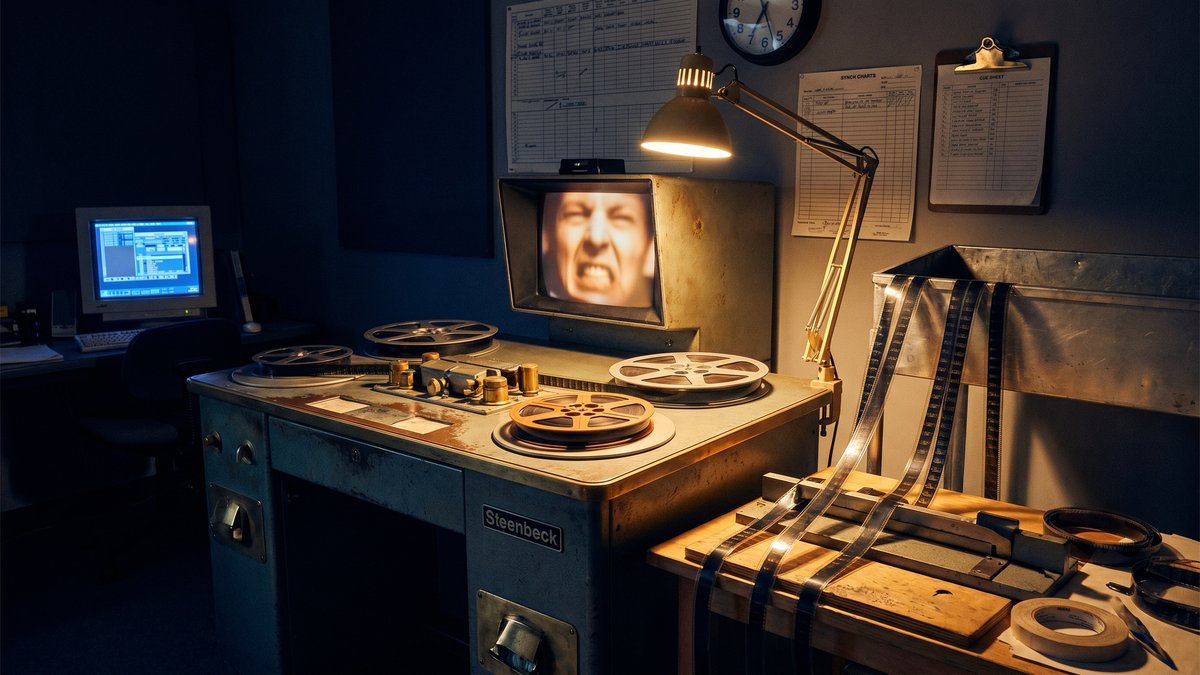
"I had cut on a Steenbeck flatbed for eighteen years. The studio wanted Avid by Christmas. I told them I'd retire first. Six months later I was learning Avid at night because there was nothing else."
That sentence was spoken, in some version, by hundreds of senior editors across North American post-production houses between 1990 and 1995. The exact wording shifts. The arc — refusal, capitulation, late-night retraining — is the one industry oral histories have documented across the Steenbeck-to-Avid transition.
It is the closest historical analog we have to what is happening to video editors, motion designers, animators, and visual-effects artists inside the 2026 AI tool wave. The parallel transition for photographers between 1995 and 2010 is the other case our research keeps returning to.
The transition restructured every cutting room in the global post-production industry between roughly 1989 and 2005. Senior editors who refused the new tool lost their careers. Junior editors who picked it up early built careers that the seniors had earned the right to. The editors who survived the disruption with their seniority intact did one specific thing.
They adopted the new tool while their senior identity was still intact.
That move has a name worth using. The non-linear pivot — taken before the linear pivot was forced, while you still had the standing to define what the new tool was for in your hands, rather than someone else's.
This is the lesson worth sitting with in 2026. The AI tool wave is doing to visual creative work what Avid did to the cutting room in 1990.
What the cutting room looked like in 1990
The senior film editor in a top-tier 1990 cutting room worked at a Steenbeck flatbed or a Moviola upright. The footage came in on physical 35mm or 16mm film. The editor's job was to find the scene inside the takes, build the cut from the strips of film, and physically splice the workprint together with tape and a guillotine.
The skills were specific and hard-won. Knowing where the cut lived in a long take. The discipline to make a hundred small choices a day, with consequences a producer would see in a screening room two weeks later. The relationship with the director is collaborative, sometimes confrontational, always under pressure. A senior editor in a feature film could earn more than the cinematographer.
The cutting room was a known economy. Editors moved between projects through long-standing relationships with producers and directors. Apprenticeship paths were clear. Assistant editors logged footage, organized trims, and learned the craft over years. The pyramid was stable.
Avid Media Composer launched in 1989. The first units cost roughly fifty thousand dollars per workstation. The first studios that bought them were experimenting. The transition looked, in 1990, like a curiosity at the edge of the industry.
It was a curiosity at the edge for a very short time.
The Avid wave, 1990–2005
By 1992, the major studios had Avid bays for the assistant editors to log on. By 1995, most independent feature films were finishing on Avid. By 1998, Steenbeck flatbeds were being moved into storage rooms. By 2003, almost every working cutting room in North America was non-linear. By 2005, the Steenbeck was a museum object.
The transition compressed a fifty-year industry rhythm into about fifteen years.
The economics shifted alongside the tool. The assistant editor role thinned because the new tool did much of what the assistant had done manually. The cost of editing infrastructure dropped as non-linear systems matured and became cheaper. The number of editors a project required fell. The hours per cut dropped. The rates for a top-tier feature-film editor held, but the middle of the bench compressed.
The path through assistant editing into a senior chair narrowed. New entrants who started on non-linear systems were faster on the tool than the seniors who had transitioned mid-career. Some studios began promoting tool fluency over cutting judgment in the early years of the transition. The mistake corrected itself within a decade, but the seniors who lost their chairs in those years did not get them back.
The editors who did not survive the transition
Three patterns ended editing careers between 1990 and 2005.
The first was outright refusal. A senior editor who would not learn the new tool by 1995 was unemployable in a top-tier cutting room by 1998. Most of the editors who refused had decades of standing in the industry. Their standing did not survive the tool change.
The second was late transition. An editor who started learning Avid in 1998, after the wave had already crested, came onto the tool as a beginner at a moment when the assistants under her were five-year veterans of it. The hierarchy reversed. Her seniority on the craft did not transfer cleanly into seniority on the tool. Many of these editors stayed in the industry, but at lower levels of project and lower rates than they had once commanded.
The third was confusion. An editor who learned the tool but kept calling herself a film editor in a market that now used non-linear editor and later just editor did not own the new category. She was perceived as an editor in transition rather than an editor of the new era. The label gap cost her work.
The editors who did survive
A specific cohort survived the transition with senior identity intact. They had two things in common.
They adopted the tool before the wave forced them. Most began on Avid between 1990 and 1994 — early, when the tool was still being defined, while their cutting credits were still recent and their standing was unambiguous. They had the standing to set the terms of the new tool in their own bays. They could say Avid does not do this; here is how I am going to do it, and the studios listened because the editor saying it was the editor whose cuts the studio trusted.
They kept the focus on what did not change. The tool changed. The judgment did not. Knowing when to cut, what to keep and what to drop, how to build pace, how to find the scene inside a long take, how to read a director's intent — none of these were Avid skills or Steenbeck skills. They were editing skills. The editors who kept saying the room above the bay — meaning, the part of editing that happens above the level of which tool you operate — kept their seniority and their rates.
The room above the bay is a label worth using. It is the part of the work that the new tool cannot eat because it does not reach the place where the work actually happens. The bay is the technical operation. The room above is the judgment, the taste, the eye, the relationship with the director.
The editors who survived insisted, loudly and consistently, that they lived in the room above the bay. The tool was downstairs. They moved between Steenbecks and Avids and now, occasionally, into AI-assisted editing systems, without ever conceding that the room above had to be renegotiated each time the tool below changed.
What the 2026 video editor, animator, and motion designer can take from this
Sora, Runway, and Veo are doing to video what Avid did to the cutting room in 1990. Midjourney with motion-extender stacks is doing to animation what desktop publishing did to layout in the 1980s. AI tweening and interpolation tools are doing to motion design what After Effects did to motion design in the 1990s. Gaussian splatting and AI scene generation are doing to 3D and VFX work what 3D rendering software did to model-making in the 1990s.
The pattern is the same in every wave. The tool eats the bay. The room above the bay is untouched. The freelancers who keep their seniority through the wave — and step out of the impossible bind the wave hands every freelancer who waits — are the ones who adopt the new tool early, set the terms of its use in their own work, and refuse to be defined by their proficiency on the tool rather than by the judgment they bring to the work.
The non-linear pivot, in 2026 language: learn the AI tool now, while your reel and your seniority on the craft are still current. Use it. Build with it. Put it in your bay. Keep your name on the room above.
The editors who delayed in 1995 spent the next decade chasing assistants who had started on the tool. The video editors and motion designers who delay in 2026 will spend the late 2020s chasing operators who started on Sora at twenty-three. The math does not work in the senior's favor unless the senior moves first.
The renaming work, again
The Steenbeck editor who survived the transition did not call herself a Steenbeck editor in 1998. She called herself an editor.
The Avid editor who survived the next transition did not call herself an Avid editor in 2010. She called herself an editor.
By 2035, the 2026 editor will introduce herself as an editor. The AI-assisted prefix will be gone from her title — the move the survivors of every prior disrupted profession made when their tool changed.
The tool name in the title is a transition marker. It says I am an editor going through a tool change. The title without the tool name says I am an editor. The second is the title that survives every wave.
The freelance video editor, motion designer, animator, and VFX artist in 2026 is being asked the same question the film editor was asked in 1990. Are you defined by the tool you operate, or by the room above the bay? The answer is the difference between the next ten years being a career and being a salvage operation.
Where Haven AI fits
The renaming work — what to call yourself when the tool below has changed, and the room above is still yours — is what Ariel was built for. The Socratic questions that surface what your judgment is in language the new market understands. The conversations the editors of 1990 had with peers, mentors, and the occasional rare coach who saw the wave before the studios named it.
The conversation is portable into 2026. The room above the bay is still yours. The tool below is changing again.
The editors who took the non-linear pivot in 1992 are the editors who are still working today. The editors who refused are not in the industry. The video editors, animators, motion designers, and 3D artists who take the equivalent pivot in 2026 will be the ones working in 2040.
The lesson is fifteen years deep. The window is open now.
In Haven AI's research across 8,300+ freelancer quotes, the AI tool wave reaching visual creative work in 2026 maps onto the Avid-to-Steenbeck transition of 1990 with a precision that is hard to dismiss. The pivots that worked then are working now.