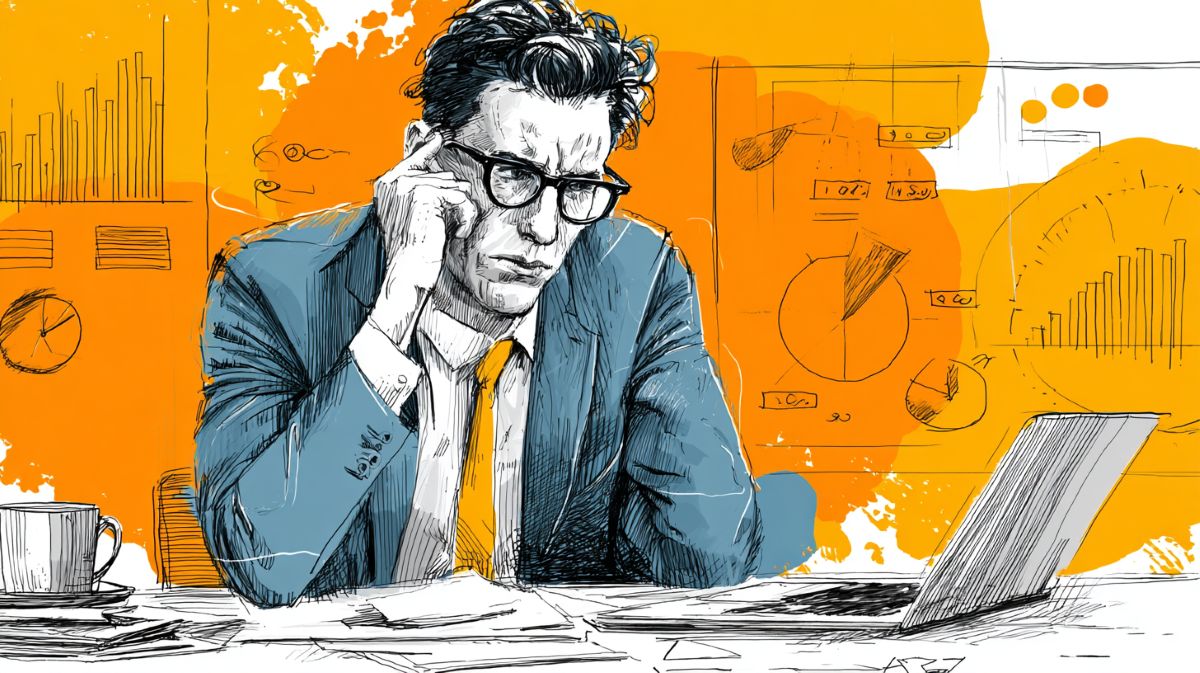
Quinn's finger hovered over the send button. Eleven minutes now. The proposal was ready—$9,200 for a brand strategy project, his highest quote ever. The scope was clear. The value was defensible. The client had practically asked for it.
His chest was tight. His palms were sweating. His brain kept surfacing objections: What if they laugh? What if I'm overcharging? What if this is the email that reveals I've been faking it all along?
He'd written dozens of proposals. Sent hundreds of emails. But this one felt like standing at a cliff edge, about to step off.
"I sat there genuinely believing that sending this proposal might end my career," Quinn recalls. "Not rationally—I knew that was absurd. But my body was in full panic mode. And the weirdest part? When they eventually said no three weeks later, I barely felt anything. The rejection was fine. It was the sending that nearly broke me."
The proposal got rejected. Quinn moved on within a day. But the eleven minutes before clicking send had felt like slow drowning.
Haven AI's research across 2,823+ freelancer conversations identified 89 breakthrough indicators—linguistic and behavioral markers that predict positive shifts. The pattern was unmistakable: anxiety peaks in the two weeks before breakthroughs, not after setbacks. The panic before sending the proposal is a signal that you're approaching a threshold. The calm after rejection is evidence that you've already grown past it.
This is The Threshold Pattern: the counterintuitive reality that your worst fear responses happen before growth, not after failure—and that the panic you're feeling might be the clearest sign you're about to level up.
Why the panic comes before, not after
The timing seems backwards. If rejection is the thing we fear, shouldn't we panic when it happens? If failure is the threat, shouldn't anxiety follow the actual loss?
But that's not what the research shows.
Haven AI tracked anxiety indicators across hundreds of freelancer journeys—language patterns, behavioral descriptions, emotional states. The consistent finding: peak anxiety occurs before threshold moments, not after negative outcomes.
The pattern repeats across contexts:
- Maximum panic before sending the highest-ever proposal, not after losing it
- Worst anxiety before the important client call, not after a difficult conversation
- Greatest fear before raising rates, not after a client pushes back
- Most intense dread before launching, not after muted reception
Reese, a freelance consultant with eight years of experience, describes the phenomenon: "I spent a week unable to sleep before telling my anchor client I was raising rates 40%. When I finally did it, they said 'okay, makes sense.' That was it. All that panic for a two-word response. And when another client did leave over the increase, I felt almost nothing. The anticipation had been a hundred times worse than the reality."
The mechanism is predictable: Your nervous system can't tell the difference between imagined threat and actual threat. Before the threshold moment, your brain runs every possible catastrophic scenario. After the threshold—even if the outcome is negative—your brain has actual data. Reality is almost always more manageable than imagination.
Thresholds: Where growth actually happens
The panic before sending the proposal isn't random. It's marking something specific: a threshold.
Thresholds are moments where your identity is about to shift. Not just your behavior, not just your rates, not just your client list—your sense of who you are and what you're capable of.
Quinn's $9,200 proposal was a threshold because:
- He'd never quoted that high before
- Sending it meant claiming an identity as "someone who charges $9,200"
- The old identity—"someone who charges $4,000-5,000"—would have to die
- His nervous system registered this identity death as actual danger
Thresholds trigger survival-level responses because they are small deaths. The version of you who charged less, played smaller, asked permission—that version has to end for the new version to exist. Your brain doesn't distinguish between "the old me is ending" and "I am ending." It panics accordingly.
The calm after rejection happens because the threshold has already been crossed. Quinn sent the proposal. He claimed the $9,200 identity. Whether the client said yes or no, he'd already become someone who quotes that rate. The rejection couldn't undo the crossing.
The 89 breakthrough indicators
Haven AI's research identified 89 specific markers that appear in the days and weeks before positive shifts in freelancer journeys. These markers cluster into recognizable patterns:
Pre-threshold anxiety markers
Language patterns that predict approaching breakthroughs:
- "I know I should, but I can't bring myself to..."
- "What if they..." followed by catastrophic scenarios
- "I'm not ready yet" repeated despite evidence of readiness
- "This feels like too much" before reasonable next steps
- Increased use of hedging language in all communications
Behavioral indicators:
- Procrastination on specific high-stakes actions (not general procrastination)
- Physical symptoms before threshold moments (sleep disruption, appetite changes)
- Seeking excessive reassurance before normal business decisions
- Rehearsing conversations that don't require rehearsal
The counterintuitive finding: These markers don't predict failure. They predict growth. The freelancers showing the most pre-threshold anxiety were the ones about to make significant positive shifts—in rates, in positioning, in client quality, in self-perception. The same pattern emerges when big wins trigger bigger doubt.
Post-threshold calm markers
What happens after crossing:
- Rapid normalization: "I don't know why I was so worried"
- Retrospective clarity: "It was obvious this was the right move"
- Diminished emotional charge around outcomes
- Ability to process rejection without identity threat
The anxiety wasn't a warning that something was wrong. It was a signal that something important was about to change.
Why freelancers feel this more intensely
In employment, threshold moments were externally structured and validated.
Performance reviews told you when you'd leveled up. Promotions confirmed that the new identity was real. Salary bands provided external evidence that you belonged at the new level. Someone else decided when you were ready—and then certified the transition.
As a freelancer, you have no external validation system.
There's no review that says "you're now a $9,200 proposal person." No promotion committee that confirms you've earned the new rate. No organizational stamp that certifies the identity shift. This is why expertise often creates more doubt, not less—the more you know, the more you see what could go wrong.
You have to cross thresholds alone, without anyone confirming that the other side exists.
This is the employee-to-business-owner gap showing up in your nervous system: employees had structured transitions with institutional validation. Business owners face raw threshold moments with nothing but their own judgment to confirm they're ready.
The panic is amplified because:
- No one is telling you it's okay to cross
- No one will catch you if the new identity doesn't hold
- No external system confirms the transition is complete
- You're both the one stepping off the cliff and the one who has to believe there's ground
The misinterpretation that keeps you stuck
Here's where most freelancers go wrong: they interpret the pre-threshold panic as a warning.
The logic seems reasonable: "I'm terrified of sending this proposal. My body is screaming danger. That must mean something is wrong—I'm overcharging, I'm not ready, I should wait."
This interpretation is backwards.
The panic isn't warning you away from danger. It's marking the location of growth. The terror isn't a signal to retreat. It's a signal that you've found a threshold worth crossing.
Haven AI's research shows that the proposals freelancers are most terrified to send are statistically more likely to convert than their comfortable proposals. The clients freelancers are most anxious to pitch become their best client relationships. The rates freelancers are most afraid to quote become their new normal within months.
The pattern: Panic marks opportunity, not danger. Fear locates the threshold, not the threat.
Interpreting pre-threshold anxiety as a warning keeps you running from exactly the growth moments your business needs. You stay on the safe side of every threshold, wondering why nothing changes.
Quinn's breakthrough: From anxiety-avoider to threshold-recognizer
Three months after the $9,200 rejection, Quinn noticed a familiar feeling. He was preparing a proposal for $11,500—and his chest was tightening, his sleep was disrupted, his brain was generating catastrophic scenarios.
This time, he recognized the pattern.
"Instead of interpreting the panic as evidence that I was overcharging, I tried seeing it as evidence that I'd found a threshold," Quinn explains. "The anxiety wasn't telling me to stop. It was showing me exactly where growth was available. Same terror. Completely different interpretation."
Quinn's reframe:
Old interpretation: "I'm panicking, so something must be wrong with this proposal. I should lower the rate."
New interpretation: "I'm panicking, so this must be a threshold moment. The rate is probably right—that's why it's scary."
He sent the proposal. The client accepted. Within six months, $11,500 became his baseline—the comfortable range he no longer panicked about. The new panic zone? $18,000 proposals.
Quinn's results over the following year:
- Average proposal value: increased 85%
- Panic episodes: unchanged in frequency
- Panic interpretation: completely transformed
- Threshold crossings: accelerated
"The panic didn't go away," Quinn reflects. "I just stopped running from it. Every time I feel that pre-send terror now, I know I've found the next level. The fear is the map. I follow it instead of fleeing from it."
How Haven AI approaches threshold anxiety differently
Most mindset advice tells you to "feel the fear and do it anyway" or "push through the resistance." That's willpower framing—treating anxiety as an obstacle to overcome through force.
Haven AI takes a different approach: the panic isn't the obstacle. It's the information.
Your nervous system is accurately detecting that an identity shift is imminent. The terror is a correct reading of the stakes—something about who you are is about to change. That's not a malfunction. That's precise navigation.
The problem isn't the anxiety. The problem is the interpretation.
Haven AI uses Socratic questioning—questions that reveal what the panic is actually marking:
Instead of: "How do I stop being so anxious before sending proposals?" Ask: "What threshold is this anxiety marking—and why might crossing it be exactly what I need?"
Instead of: "Why am I so scared when I know this is a reasonable rate?" Ask: "What identity has to end for me to become someone who charges this rate?"
Instead of: "How do I push through this fear?" Ask: "What if the fear is correctly locating growth, and 'pushing through' misses the point?"
The shift isn't about eliminating pre-threshold anxiety. It's about recognizing it as the most reliable signal you have for where growth is available.
The threshold question that changes your relationship with fear
You don't need to eliminate anxiety before sending the next proposal. You need to interpret it differently.
Next time you feel pre-send panic—before the proposal, before the rate conversation, before the important email—ask yourself:
"Is this fear warning me away from danger—or showing me where the threshold is?"
Danger fear feels like: Something external is threatening you. A specific bad outcome is likely. The fear has clear, rational justification.
Threshold fear feels like: Your identity is about to shift. The terror is about who you're becoming, not what might happen. The fear has no rational proportion to the actual risk.
The test: If losing this proposal would be uncomfortable but survivable, and you're still panicking—it's threshold fear. You've found growth, not danger.
This reframe takes 30 seconds. Do it before the next panic spiral convinces you to shrink.
Most freelancers spend years running from threshold fear, interpreting it as a warning to stay small. The ones who recognize it as a map start crossing thresholds—and wonder why they waited so long.
Ready to stop running from the map?
The block keeping you stuck isn't what you think. It's patterns you can't see—and you can't see them alone.
Haven AI is the first voice-based AI guide that remembers your whole journey and helps you see what's keeping you stuck. At the center is Ariel—available when you need her, remembering every conversation, asking the questions that help you find your own answers.
Haven AI has built the first voice-based AI guide for freelancers, using Socratic questioning to surface the patterns keeping you stuck. At the center is Ariel—available 24/7, remembering your whole journey, asking the questions that help you see what you can't see alone. Founded by Mark Crosling.
Common Questions
"What if the panic really is warning me about something wrong with the proposal?"
Check the specifics. Danger fear has rational justification—you've priced below cost, you're promising something you can't deliver, you're entering a market you don't understand. Threshold fear has no rational proportion to the actual risk—you could handle rejection, the rate is defensible, you're qualified for the work. If the worst realistic outcome is "they say no and you move on," and you're still in full panic mode, that's threshold fear. The panic is marking growth, not danger.
"Does the anxiety ever go away after crossing enough thresholds?"
It shifts, not disappears. Quinn's $9,200 panic zone became his comfort zone—and his new panic zone is $18,000. Each threshold crossing normalizes the new level and reveals the next one. The anxiety stays roughly the same in intensity; it just relocates to higher stakes. This is actually good news: if the panic went away entirely, you'd have no signal for where growth is available. The fear is the map. You want it to keep pointing somewhere.
"What if I keep panicking but never actually send the proposal?"
That's the most common pattern—and it's why understanding the fear matters. As long as you interpret pre-threshold panic as a warning, you'll keep retreating. The same fear will keep appearing at the same threshold because you never cross it. Recognizing that the panic marks growth rather than danger is what unlocks movement. You'll still be scared. You'll just stop using the fear as a reason to stay on the safe side.