"Being repeatedly told subconsciously if not directly that your expertise is not valued or needed anymore — that really dehumanizes you." — Anonymous, marketing freelancer
Over the last 14 months, we've collected 8,300+ freelance voices like this one. The pattern across them is the most consistent thing we've ever seen in this work.
I. The Pattern
The same fear shows up in three vocabularies, depending on which family of work the freelancer comes from.
From a freelance therapist:
"My younger clients openly tell me they process things with ChatGPT between our sessions. One said, 'It remembers everything I've told it and it never cancels on me.' I didn't know whether to laugh or cry." — Anonymous, freelance therapist
From a working illustrator:
"I keep hearing 'you're so good, your work is amazing,' and then silence. Follow-up leads to ghosting. Where are the clients who still hire illustrators? They are now completely out of reach." — Anonymous, freelance illustrator
From a senior developer:
"Five years ago, there was a real war for coders and developers. Since the rise of AI, it has dropped dramatically. I don't even think it's touching 5%. It's almost completely vanished." — Anonymous, freelance developer
Three people from three different industries describing the same structural displacement, in three sentences, none of them rehearsed with each other. Same fear, different vocabulary.
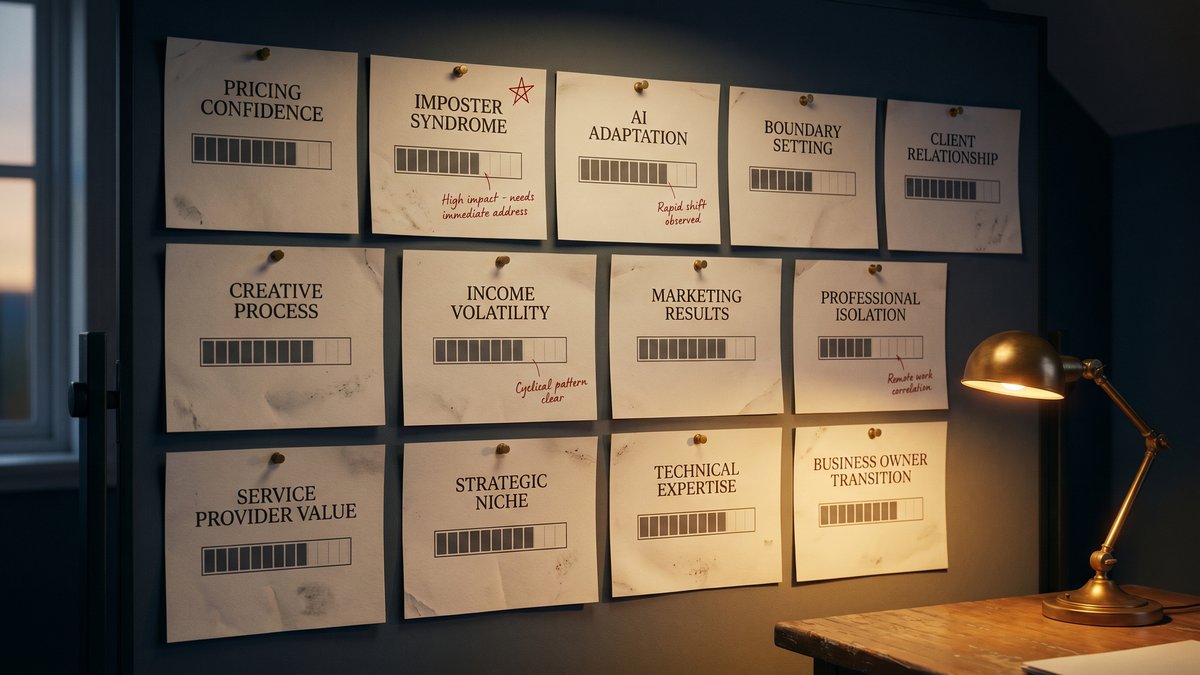
In our research across 8,300+ freelance voices, AI displacement language appears in 13 of 13 modules we track — from pricing confidence to imposter syndrome to boundary setting, from professional isolation to creative process to client relationships. There is no module where it does not show up. The fear has spread into every adjacent domain of freelancer struggle.
That part is the methodology check that matters. We are not picking modules where AI shows up. We are reporting what the data shows, regardless of which struggle a freelancer initially came to talk about.
Haven AI is a voice-based coaching service for freelancers, with memory that persists across sessions. The 8,300+ voices in this report were collected across published forums, articles, podcasts, books, industry coverage, and a live Reddit VOC pipeline that scrapes 60+ freelance subreddits. Eight occupation families are tracked — Creative, Content, Marketing, Technical, Healthcare, Business, Service, and General — across 13 coaching modules. The methodology gives signal you do not get from surveys or interviews because freelancers speak more honestly in their own forums than in research settings, where the question itself shapes the answer.
But here is what makes this fear different from every previous wave of automation anxiety.
II. Why This Is Different
Every previous wave triggered the same fear: the machine will take my job. Manufacturing in the 1970s. Outsourcing in the 1990s. The gig economy in the 2010s. Each was about the substitution of human labor by cheaper labor — mechanical, geographic, or both.
The fear this time is different in kind. The 1970s factory worker thought the machine will take my job. The 2026 freelancer thinks the value I sell is no longer scarce. Listen to one freelance copywriter:
"Will AI replace copywriters in 2025? The question itself is the wound. Every time a client asks it, every time a headline screams it, I feel a piece of my professional identity chip away." — Anonymous, freelance copywriter
That is an identity claim with downstream economic consequences. The order matters: the identity wound comes first, and the rate compression follows from it. Treating the rate compression alone misses what is actually breaking.
We have a name for this pattern internally. Identity threat. Not Imposter Syndrome 1.0 — the question of whether you are good enough at the work. Imposter Syndrome 2.0 — the question of whether the work itself still matters.
The shift is subtle and structural. The 2010s copywriter wondered whether her landing page was clever enough. The 2026 copywriter wonders whether anyone is going to need landing-page copy from a human in five years. The first question is anxiety inside a stable category. The second is anxiety about whether the category still exists.
This affects high-skill and entry-level freelancers alike. The senior copywriter and the junior copywriter are now asking the same question — and that itself is diagnostic. In previous waves, seniors were insulated, and juniors carried the displacement. This time, the pyramid is being squeezed from both ends.
The economic signal is quiet. It does not appear in BLS data as job loss. It appears as rate compression, quiet attrition, and freelancers exiting the field "by choice." Across the voices we have collected, it appears as the same sentence in a thousand vocabularies: I do not know what to call myself anymore. I do not know if what I do still counts.
The conventional toolkit for this kind of crisis was built for different problems.
III. Why Current Solutions Don't Fit
Four supports are reached for. Each is useful for what it was built for. None of them was built for this.
Therapy gets the emotion and misses the economics. Identity threat is half existential, half practical. A therapist can sit with the grief, but cannot help a freelancer price the next project, write the rate-defending email, or read whether a client conversation went sideways. Half the wound is unattended. The unattended half is the one that pays the rent.
Business coaching is the inverse problem. It is built for strategy, positioning, and sales operations. It treats this as a market problem and prescribes a market solution — niche down, charge more, build a funnel. But the freelancer staring at a "Why pay you when ChatGPT is free?" email is not blocked on strategy. She is blocked on whether what she does is still worth doing — and whether what she is, as a professional, still counts. Coaching does not reach there.
AI tools — ChatGPT, Claude, Gemini — have added flat fact-storage memory in the last two years, but not the longitudinal coaching memory that identity work requires. They remember your preferences; they do not hold the arc. None have a Socratic mode by default. The deeper problem is architectural: the tool that is the cure and the tool that is the cause are the same tool. Freelancers describe a loop. Feel anxious about AI. Open AI to feel productive about the anxiety. Watch the tool perform the displacement in real time. One developer named it:
"I slowly watched my technical skills get worse. All while I was playing with ChatGPT like a slot machine." — Anonymous, freelance developer
That is the loop in one sentence.
Peer communities — Reddit, Discord, Slack groups — are high signal in aggregate. (We know. We built this research on Reddit.) But they are low signal per individual conversation. Threads decay, advice contradicts, anonymity erodes credibility, and no community is there at 2am when the fear peaks. Peer communities are useful for recognition — for the freelancer realizing she is not alone. They do not move resolution.
What does fit, then?
IV. What Actually Works
The problem requires four properties. Together, no existing tool provides them. Listing them is the architectural argument.
Voice. Typing about identity is too cognitively expensive when you are in the moment of feeling it. Voice lowers the activation energy — you can speak the thing you could not bear to write. The fear that has been circling all afternoon comes out of the mouth in a way it never comes out of the keyboard. This is not an aesthetic preference. It is the difference between articulation and avoidance.
Memory. "I told you last week" is the whole point. Identity work happens across sessions, not inside one. A coach who forgets undoes the work; a coach who remembers compounds it. The freelancer who said three weeks ago that her real fear is being unbillable — and is now describing a rate-defending conversation — needs both conversations held as one thread, not two unrelated visits. Without that link, every session starts from zero. With it, every session lands further than the last.
Socratic mode. No advice received matches the conviction of an answer discovered. Especially on identity. Advice is what someone else thinks you should do; insight is what you find out is already true about yourself. A Socratic question that lands, surfaces a sentence the freelancer has been carrying for months but has never said out loud. Once it is said, the rest of the work becomes possible. Advice cannot do that work because it skips the discovery.
Research-at-scale. Patterns in identity threat become visible across thousands of voices, not dozens. A coach holding 8,300+ voices in its methodology recognizes the pattern in your one voice before you have words for it — and can name what you are going through with the calibration of having heard it a thousand times in slightly different vocabulary. This is what makes coaching feel like recognition rather than diagnosis.
This stack — voice + memory + Socratic + research-at-scale — is what we have built at Haven AI. Live since March 2026.
What does this mean for the larger picture?
V. The Implication
Roughly 36% of the US workforce now freelances. The portion experiencing meaningful identity threat from AI is a meaningful share of that — tens of millions of US workers, by any directional read of the data.
No tool is being built for them at an architectural scale. Coaching incumbents are built for executives and corporate populations. Wellbeing apps are built for general anxiety, not for the specific experience of being economically displaced by the thing you are using to draft your invoice. Voice-AI scaleups are building voice as input mode, not as the access path to identity work. Freelancer and creator platforms have not yet noticed that the loneliest hour of the freelance career is now the one when their most experienced users quietly disengage.
The gap is structural, not incidental. Each of the existing supports lacks at least one of the four properties this problem requires. Their combined absence is what defines the gap; no single one of them grows into the answer by adding a feature. The architecture has to be designed for the problem, not retrofitted around it.
If you are a founder, investor, product head, or platform thinking about how to support your freelance or creator users through this — we would love to talk. Email partnerships [at] havenai.io, with what you are working on. We are interested in good company on this problem, and we have more research to share than fits in one essay.
The freelance marketer who said her expertise was being made to feel dehumanized — that is the person we built Haven for. There are tens of millions of her.