In November 1982, at the COMDEX trade show in Las Vegas, a startup called Autodesk demonstrated a drafting program that ran on a desktop microcomputer. They shipped it the following month as AutoCAD. Within a generation, the software had done to architecture's oldest daily labor what the sewing machine did to hand-stitching: it took the making.
For four centuries, every building began as pencil on paper, and every architecture office was organized around that fact. This is the story of what the tool emptied, what it couldn't touch, and why the profession that lost its defining artifact is still here — with a ledger 2026 freelancers should read closely, because a new generation of tools is now drawing for everyone.
The room the machine emptied
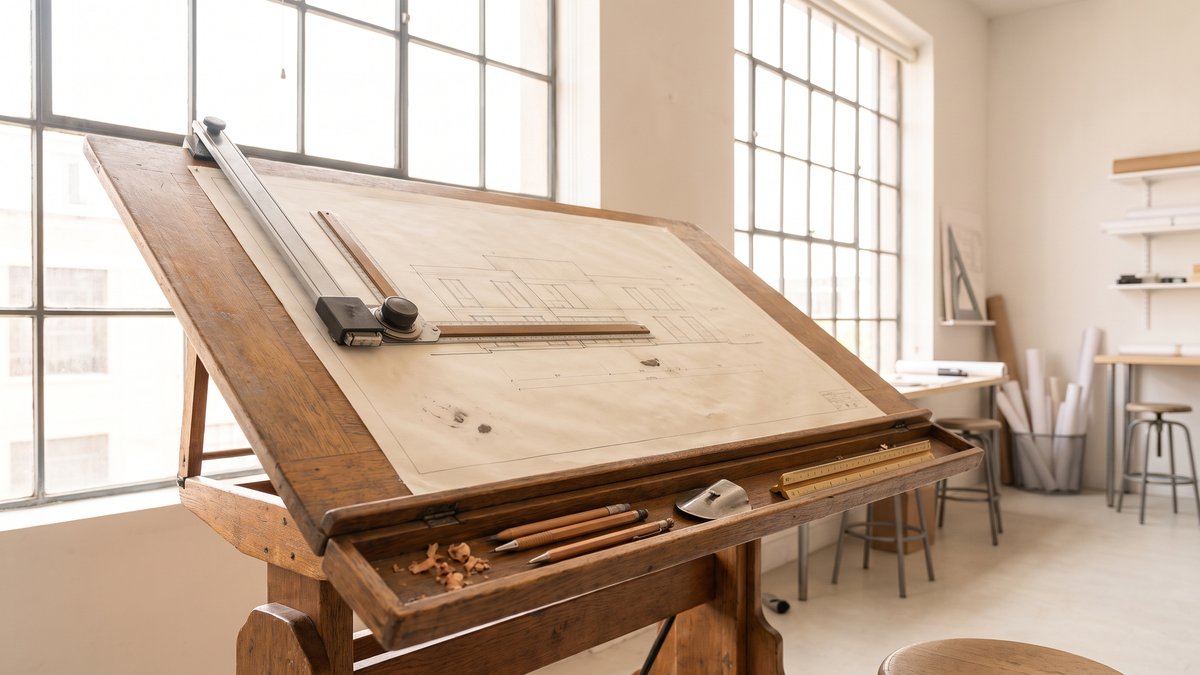
Before 1982, the heart of an architecture firm was the drafting room: rows of tilted boards, parallel rules, lead holders, and the specific hush of a floor full of people drawing. The room ran on a hierarchy of the hand. A junior spent years on door schedules and detail sheets before anyone let them near design. Drafting was how the profession trained its young — judgment was absorbed through the pencil, one redrawn corner at a time.
The drawing itself was the deliverable, the contract, and the craft in one artifact. A set of construction documents was months of coordinated handwork, and a firm's drafting capacity set the ceiling on how much it could build.
CAD didn't argue with any of that. It just made the drawing cheap. Through the late 1980s and the 1990s, the boards came off the office floors and the terminals went in — the redraw that once cost a week now cost a keystroke, and the economics of the drafting room went the way of the hand-sewn seam.
The op-ed that read the eulogy
The profession felt the loss where this series has learned to look: in identity, not just headcount.
In September 2012, Michael Graves — one of the most influential American architects of his generation — published an op-ed in The New York Times titled "Architecture and the Lost Art of Drawing." It opened by noting how fashionable it had become in architectural circles to declare "the death of drawing," and it pushed back with the argument of a man defending his trade's inner life: drawing wasn't documentation, it was thinking. The hand hesitates, revises, discovers. The speculative sketch was where architecture actually happened, and Graves feared the profession was automating away the very act through which it reasoned.
Thirty years after AutoCAD shipped, one of the field's masters was still litigating what the tool had taken. Hold that timeline: the identity argument outlives the economic one by decades. Freelancers grieving what AI took from their craft this year are on schedule, and the grief is real. But the drafting-room story doesn't end where Graves feared it would.
What happened to the people who drew?
Here's the ledger, four decades on, from the US Bureau of Labor Statistics.
The occupation built on the artifact — the drafter — stalled. The BLS counts 192,100 drafting jobs in 2024 and projects the total essentially flat through 2034, in a decade when overall employment grows. Look inside the number and the pattern sharpens: mechanical drafters are projected to decline 7 percent and electrical drafters 6 percent, while architectural and civil drafters — the ones closest to sites, codes, and buildings that can kill people if drawn wrong — are projected to grow 4 percent. Even within the drawing trade, the work that survived is the work nearest to consequence.
The occupation built on the judgment grew. The BLS projects architect employment rising 4 percent through 2034, with about 7,800 openings a year. The profession absorbed the tool completely — no architect under sixty has ever priced a project by drafting capacity — and kept the parts the tool couldn't run: the design intent, the client's trust, the code compliance, the liability.
That last item deserves its own sentence, because it's the quietest moat in this story. Every set of construction documents still requires a licensed architect's stamp, and the stamp is the legal instrument that makes a human answerable for the building. CAD never got a license. The software drew everything and signed nothing. Forty years of automation moved the drawing from hand to machine and never moved the accountability an inch.
The pattern, named
This series has a name for what the drafting room went through: the judgment shift — automation drains the routine out of a role and refills it with judgment, relationship, and problem-solving. The bank tellers lived it when the ATM took the cash-handling. The architects ran the same arc with a sharper split: the drawing and the judgment had been fused in one artifact for four centuries, and CAD cleaved them — the artifact went to the machine, the judgment went up in value, and every career in the field re-sorted along that line.
The tool also built rungs sideways while it sawed off the bottom ones. Whole roles that didn't exist in 1982 — the CAD manager, and later the BIM coordinator running a building's entire digital model — grew up around managing the machine's output. The pattern repeats in every mechanized trade: the artifact's makers shrink, and a smaller corps of people who govern the machine's version of the artifact forms in their place, at better pay and closer to the decisions.
The training ladder was the harder casualty. The drafting room was where juniors absorbed judgment through years of supervised repetition, and the tool removed the bottom rungs — a problem the profession is still improvising around, and one the AI era has now handed to every knowledge trade at once. The judgment that survived the machine still has to come from somewhere, and nobody has rebuilt the room where it used to be taught.
What the drafting room says to 2026
The echo hardly needs drawing out. Generative tools now produce renderings, floor plans, and full drawing sets from prompts — the artifact side of another dozen trades is going where the pencil went. Three lessons from the trade that ran this arc first.
First — the artifact is always the machine's first meal. The drawing looked like the profession; it was actually the profession's most automatable layer. Whatever your trade's equivalent is — the draft, the deck, the code, the render — price it as the part the machine will eventually eat, and build your income on what's left when it does.
Second — proximity to consequence protects. The drafters who survived are the ones whose lines connect to building codes and site conditions — drawings that carry real-world stakes. The same gradient runs through every profession the machines have entered: the closer your work sits to consequences someone must answer for, the harder it is to automate away.
Third — the stamp survives. The deepest thing the architects kept wasn't drawing skill. It was answerability — the license, the signature, the name on the documents. This series keeps arriving at the same wall from different directions: the machine's plan needs a human who signs, because no subscription carries liability. The architects had it codified in law a century before the machines arrived. Freelancers have to build it into their positioning by hand — but it's the same asset, and it doesn't depreciate with the next model release.
Graves was right that something real died with the drawing. The profession grieved it, absorbed the tool, and kept the stamp. Four decades on, the machine still drafts and still doesn't sign.
In Haven AI's research across 8,300+ freelancer quotes, the architects' arc is the cleanest historical run of the judgment shift: CAD took the drawing — the artifact a four-century-old profession was organized around — and the profession survived on what the tool couldn't hold: design judgment, client trust, and the licensed stamp that makes a human answerable for the building. The trades meeting their own drafting moment in 2026 inherit that map, and its quietest lesson: the machine draws everything and signs nothing.