On August 12, 1851, Isaac Singer patented what Britannica calls the first practical sewing machine. It ran roughly nine hundred stitches a minute. An accomplished hand seamstress managed about forty.
Every tailor alive could do that arithmetic. A shirt that took fourteen hours of handwork could now be assembled in about one. The machine had arrived for the oldest skilled trade there is — and what happened over the next 175 years is the most complete map this series has found, because the tailors ran every strategy a displaced trade can run. One of them still works.
The trade that owned the body
Before the machine, clothing barely existed as a product. It existed as a service.
A US government report in 1811 found that two-thirds of all garments worn in the country were made at home. Nearly everything else came from a tailor or dressmaker, cut for one specific body. There was no "size medium." There was your chest, your shoulders, your stance, taken down in a tailor's notebook. The measurement was the trade.
Then the machine made sewing cheap — and a war made bodies standard.
The army that standardized the body
Mass-producing Union uniforms in the Civil War generated measurements on a scale no tailor had ever seen. The Smithsonian's landmark history of American clothing, Suiting Everyone, traces what happened next: the recurring ratios in those measurements became commercial sizing. One number — the chest — could now predict the rest of a man well enough to sell him a coat sight unseen.
That discovery, plus Singer's machine, built ready-to-wear. In the late 1860s, about a quarter of American-made garments were ready-made. By 1890 it was 60%. By 1951, 90%. The depression of 1873 did its part — as one industry history puts it, men accepted "less costly, off-the-rack garments as a satisfactory substitute for tailor-made suits" when money got tight.
Read that arc from a tailor's chair. The trade didn't lose a competition. The category left. Within two generations, the default way humans acquired clothing stopped involving a tailor at all.
What the peak looked like from one shop
The scale of what shrank deserves one concrete ledger.
Henry Poole & Co, founded in 1806 and the first tailor to open onto Savile Row itself — the firm the Telegraph calls the "founder of Savile Row" — employed 300 tailors and 14 cutters in 1902, and made some 12,000 bespoke garments that year. One firm.
Today, by the Savile Row Bespoke Association's own 2019 count, the whole street holds 19 tailoring houses employing around 400 tailors. The Row's total output is on the order of 7,000 suits a year by the last widely cited count. The entire modern street produces roughly half of what one Victorian firm managed alone. That's the honest arithmetic of the collapse, and this series doesn't soften those numbers — the watchmakers' ledger read the same way.
But the interesting part of this story isn't the shrinking. It's the two things that refused to shrink on schedule.
The word they went to war over
In June 2008, the UK's Advertising Standards Authority handed Savile Row a defeat that every 2026 freelancer should study.
A company at 10 Savile Row was selling suits measured once in London, then cut and sewn largely by machine in Germany, for about £495 — and advertising them as "bespoke." The Row's tailors, whose bespoke meant a unique pattern and dozens of hours of handwork, complained. The ASA ruled against them: by the dictionary, bespoke just means made to order, and the average buyer wouldn't be misled.
The trade body compared "bespoke" to a protected term like Champagne — and lost anyway. Its chairman, Mark Henderson, drew the line the adjudication wouldn't: "You are looking at the difference between a fine painting and a print."
Sound familiar? Two days ago this series watched freelancers lose the names of their trades — illustrator renamed AI janitor, strategist renamed editor — and the rate follows the name. The tailors lost their word the same way: the cheaper tier reached up and took the top tier's label, because the label was where the price lived. Words don't stay owned. Substance has to hold you when they go.
The tier that was built on the machine
Here's the chapter the romantic version of tailoring history skips — the middle tier, and how big it got.
Decades before anyone mourned the trade, British "multiple tailors" industrialized the measurement itself. Montague Burton's shops — 595 of them by 1939 — measured a man in the store, then cut his suit in a Leeds factory. The trade called it wholesale bespoke: your measurements, the machine's making, a price ordinary men could pay. When Burton's dressed the England squad for the 1966 World Cup, most of its trade was still made-to-measure.
That model never died; it went digital. Indochino, the largest of the online made-to-measure suit companies, was reporting over $100 million in annual revenue and more than 500,000 garments a year by 2019, by its CEO's own account — while conventional suit retail spent decades contracting.
Stand back and look at what actually survived every wave of mechanization: not the sewing, which the machine took in 1851. Not the label, which the ASA gave away in 2008. The fitting — a human measuring an individual and adapting the standard to them. A hundred and seventy-five years of mass production couldn't kill the fitting, because the fitting is the one part of the product the standard can't contain. Bodies didn't standardize. Only the clothes did.
The small room at the top
And above the middle tier, the full craft held — smaller, slower, and more expensive than ever.
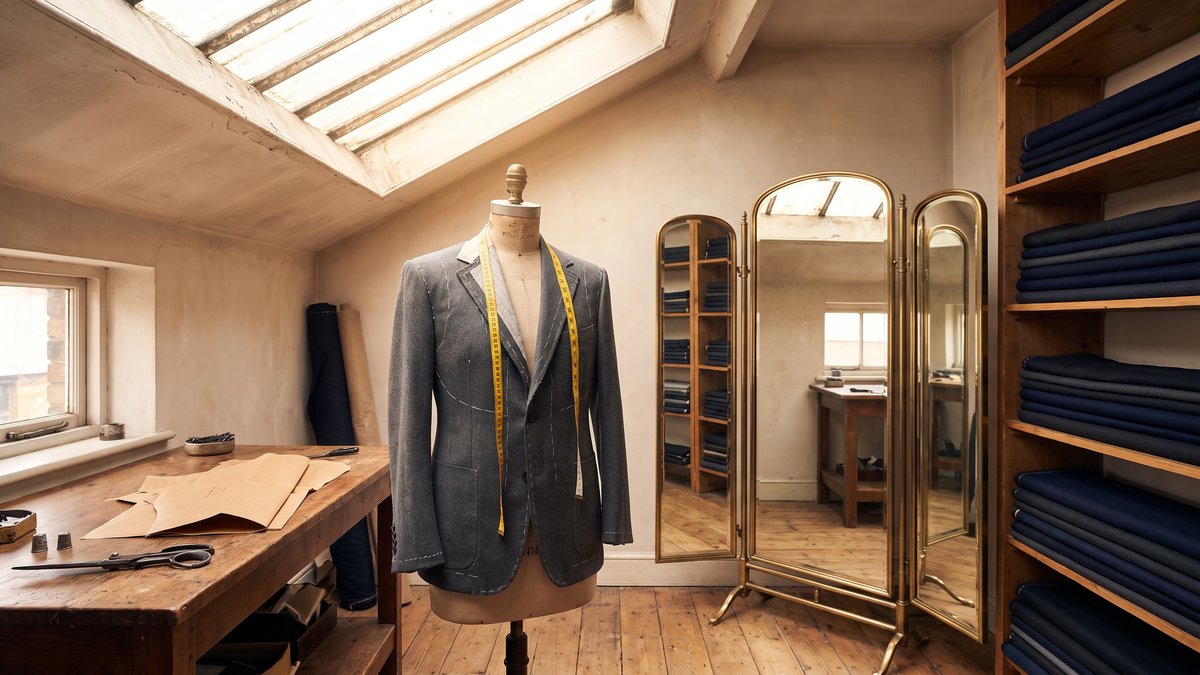
The Savile Row Bespoke Association now requires a minimum of 50 hours of hand labor in a two-piece suit. A new customer sits through about three fittings. Huntsman's bespoke starts at £4,200; most of the Row starts north of £4,000. A cutter apprentices for four to six years before the shears are theirs. Henry Poole is still on the Row, run by the seventh generation of the family.
Simon Cundey, that seventh-generation managing director, gave the trade's whole survival thesis in five words: "a figure is a figure." Every body is still individual. No sizing chart, no algorithm, no factory has changed that — so the man whose figure the standard fits badly, or whose occasion the standard can't serve, still climbs the stairs.
The Row lost the word bespoke and kept the thing itself. The clients who know the difference between the painting and the print never needed the ASA to referee it.
Name the label: the made-to-measure tier
Here's the pattern, named for 2026. The made-to-measure tier is the middle path that opens whenever mass production takes over the making: the standardized product becomes the base, and the surviving human business is measuring the individual and fitting the standard to them — priced between the rack and the full craft.
The mapping is direct. AI output is ready-to-wear: competent, fast, cut to the average client, and priced accordingly. Full bespoke — everything from scratch, no machine anywhere — is real, and it's the human-crafted premium tier: small, defensible, and not where most freelancers will live, any more than most tailors work on Savile Row.
The volume opportunity is Burton's, not Poole's. Take the machine's base and sell the fitting: the discovery call that measures this client's business, the diagnosis of where the standard answer will fail their specific case, the adaptation no template arrives knowing. The freelancer who says "nothing AI-made touches my work" is choosing the 19-house tier and should price like it. The one who measures the client and fits the machine's output to the body in front of them is running the tier that clothed a nation.
One honesty clause, from the tellers' story: tiers survive inside categories that can still shrink. The suit itself declined — US business suit sales fell by a third between 1985 and 1992 as offices went casual, long before AI. The made-to-measure tier is a position, and positions need re-reading. The fitting skill is what travels.
What 175 years of tailoring says to 2026
Three lessons, in the order the trade learned them.
First — don't fight the rack on the rack's terms. Ready-made won the category in two generations because the standard product at a standard price serves most people well enough. The tailors who survived stopped competing with it and started charging for what it couldn't do.
Second — the fitting scales. Burton proved you don't have to choose between artisan purity and surrender. Measured-by-a-human, made-by-the-machine dressed more people than Savile Row ever did. The middle tier is a mass business, and it's built on the machine, not against it.
Third — hold the thing, not the word. The Row lost "bespoke" to an adjudication and kept the 50 hours, the three fittings, and the seventh generation. Your labels will be borrowed too — "human-made," "strategist," whatever comes next. Substance survives the theft of its name. Make sure what you're defending is the fitting, and the word can go.
Where Haven AI fits
The work of finding the fitting in your own trade — separating what's now the rack from the measurement only you can take — is the work Ariel was built for. The Socratic questions that locate what you actually adapt to each client, because that's the tier the machine builds for you rather than takes from you.
The tailors got no coach through their 175 years; they got bankruptcies and adjudications. You get to read their map in advance.
The machine took the sewing in 1851, the sizing in 1865, and the word in 2008. It never took the fitting. A figure is still a figure.
In Haven AI's research across 8,300+ freelancer quotes, the made-to-measure tier is the recurring middle path of every mechanized trade — mass production takes the making, and the surviving human business is fitting the standard to the individual. The tailors ran the full arc: the rack won the category, the label got taken, and the fitting outlived them both. That map is on the table for every freelancer whose trade just met its sewing machine.