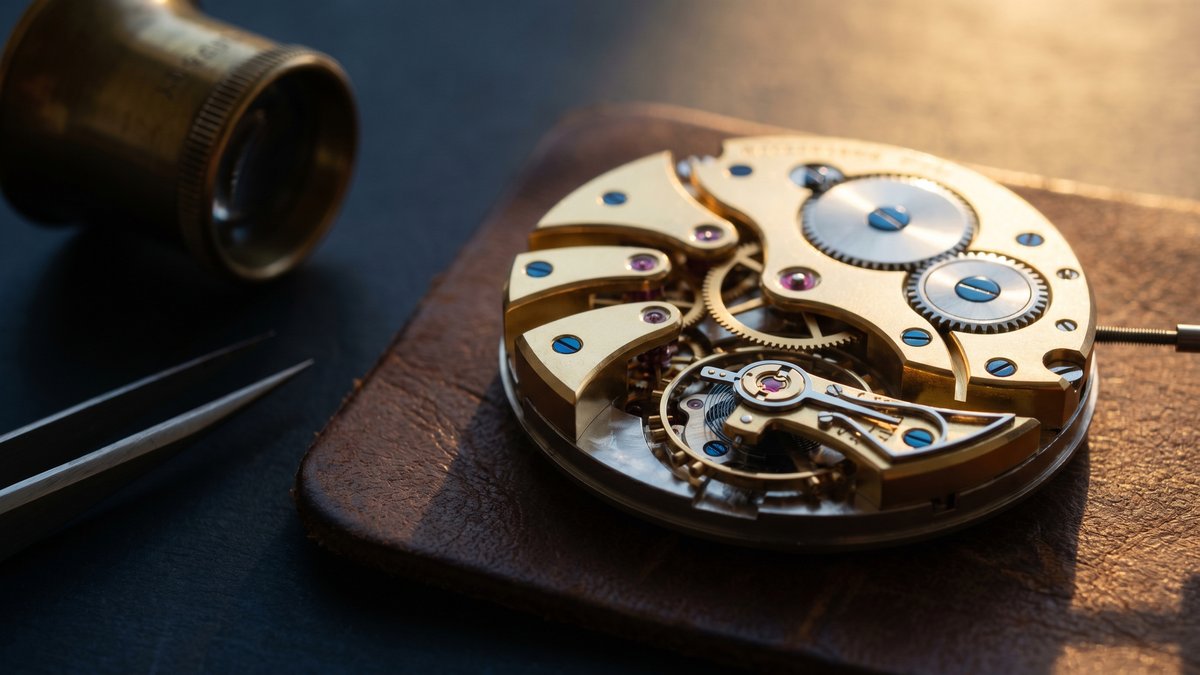
In 1970, the Swiss made roughly half the world's watches and employed about ninety thousand people to do it. By 1988, two of every three of those jobs were gone.
The thing that took them wasn't a competitor with better watchmaking. It was a cheaper technology that did the one measurable job — keeping time — better than three hundred years of Swiss craft, for a fraction of the price. It was called quartz. And the way a few Swiss houses answered it is the clearest forty-year map any freelancer staring down AI can read.
The flood that took the trade
A quartz movement keeps time by vibrating a tiny crystal. It's more accurate than the finest mechanical watch, costs almost nothing to mass-produce, and needs no master watchmaker to assemble. When it arrived as a consumer product around 1969, it did to the watch what AI is doing to the written word: it made the expensive, skilled version look slow and overpriced overnight.
The Swiss saw it and bet against it. They were the best mechanical watchmakers alive, and they assumed quality would hold. It didn't. By 1978, quartz watches had overtaken mechanical ones in popularity worldwide, and the cheap, accurate movement — much of it made in Japan and the United States — was eating the Swiss market from the bottom up.
The bet on superiority was the wrong bet. Quartz didn't need to be better-made. It only needed to be good enough, cheap, and everywhere. It was all three.
What the numbers did between 1970 and 1983
The lost jobs — 90,000 down to 28,000 — were only the surface. The number of Swiss watch firms fell from roughly 1,600 in 1970 to 600 by 1983. An industry that had held something like half the global market watched its share crater as the machine-made movement flooded every price tier it used to own.
A trade didn't ride that out — most of it simply ended. It's the history behind every "AI won't really change my field."
The rescue at the bottom
The recovery had two engines, and it's dishonest to tell only the romantic one. The first engine was industrial, and it wasn't craft at all.
In 1983, the two largest Swiss groups merged under a consultant named Nicolas Hayek — a man the banks had originally hired to manage the industry's liquidation, and who refused to do it. Out of that merger came the Swatch: a plastic-cased, Swiss-made quartz watch built from 51 components on automated lines, sold cheap and designed to be fun. More than 2.5 million sold in under two years. It beat the Japanese at their own game — low cost, high volume, mass production — and it stabilized the bottom of the market the Swiss had nearly surrendered.
The Swatch saved the trade's volume. But it didn't save the watchmaker. A robot assembles a Swatch. The thing that saved the human hand was happening at the other end of the market.
The tier that saved the top
A handful of houses — Patek Philippe, Audemars Piguet, Vacheron Constantin, Rolex — did something that looked, in 1980, close to insane. They kept making mechanical watches by hand, and they raised the price.
They had grasped what the panicking middle of the industry hadn't: once quartz won on accuracy, accuracy stopped being the product. A buyer who only wanted to know the time could get it more precisely from a ten-dollar quartz than from a hand-finished movement that took a master months to build. So the mechanical houses stopped selling time. They sold the hand. The heritage. The hundreds of hours of finishing no machine performed. The name engraved on the dial.
A mechanical watch became a piece of craft you wore — an heirloom, a signal, an object whose entire value was that a skilled human made it slowly when a machine could have made it instantly. Call it the craft tier: the deliberate move up-market into the one thing the cheap machine could never manufacture, which was the human who didn't need to make it at all.
The proof is in what buyers will pay. They know all of it and pay anyway, sometimes the price of a house, for the human who made it and the certainty that no machine did.
Why the craft tier held for forty years
The craft tier did more than buy time. It became the foundation of everything that came after.
Forty years on, the objectively inferior product is the premium product, and the numbers are larger than ever. Swiss watch exports reached about 27.6 billion francs in 2023, one of the highest years on record. Mechanical watches — the hand-made, less accurate, far more expensive kind — now make up around 86% of the industry's export value. Volume keeps drifting down while the value concentrated in each watch climbs, which is the signature of real pricing power. The craft tier didn't just survive the machine. It became the whole worth of the industry.
The reason it held is the reason it will hold for the freelancer. Everything the craft tier sells — the human hand, the time visibly invested, the heritage, the named maker — is precisely what a cheap machine cannot counterfeit. And the relationship runs backwards from what the 1975 Swiss feared. The more accurate and abundant quartz became, the more a hand-made movement was worth, because the human in it grew scarce as the machine grew common. Scarcity of the hand inverted the value.
The 2026 translation
AI is the quartz movement. Cheaper, faster, tireless, and on the measurable jobs — clean copy, a competent layout, a passable first draft — often better than the median human, instantly and at almost no cost.
The freelancer who answers it by trying to out-produce or out-accurate the machine is the Swiss firm of 1975 betting on superiority. There were a thousand fewer of those firms a decade later. The survivors did what the mechanical houses did: they moved into the craft tier — work whose value is the human hand and the named maker, the human-crafted premium a buyer pays for because a person made it slowly.
It's the same move the illustrators made when a signature style became the named hand — the one thing a library of cheap images couldn't stock. The machine makes the commodity worthless by making it free. The same flood makes the hand-made precious by making it rare.
There's a hard part the romantic version skips. The craft tier is smaller. Swiss watchmaking never employed ninety thousand people again — the tier holds rates, not headcount. It's fewer seats, each worth far more. That's the real shape of the bind AI hands you: the path through won't restore the old volume of work. What it offers is a seat among the named hands the smaller, higher-value tier still pays for.
That's a reason to move early, while the tier is still forming and the seats aren't all taken. The watchmakers who reached the craft tier first set the terms for the forty years that followed. The ones who waited, betting the flood would recede, mostly didn't get a second chance. By the time the mechanical revival was obvious, the names that owned it were already the names.
Where Haven AI fits
The work of moving from "I produce content" or "I write code" toward the specific, named craft tier of what you do — the judgment and authorship a machine can't manufacture — is the work Ariel was built for. The Socratic questions that find the part of your craft worth a premium precisely because a person made it.
The watchmakers reached that position over a punishing decade, by feel, with two-thirds of their trade already gone. The 2026 freelancer has the whole map in advance — the flood, the collapse, the two engines of the recovery, and the tier that held for forty years.
A ten-dollar quartz keeps better time than a hand-built mechanical watch. Four decades of sales say the buyer was never paying for the time.
In Haven AI's research across 8,300+ freelancer quotes, the craft tier is the most durable survival pattern across every prior disruption — watchmakers, photographers, illustrators. When a cheap machine wins on the measurable job, the human value moves to what the machine can't make: the hand, the judgment, the named maker. The tier is smaller and pays more, and it's forming now in every field AI has flooded.