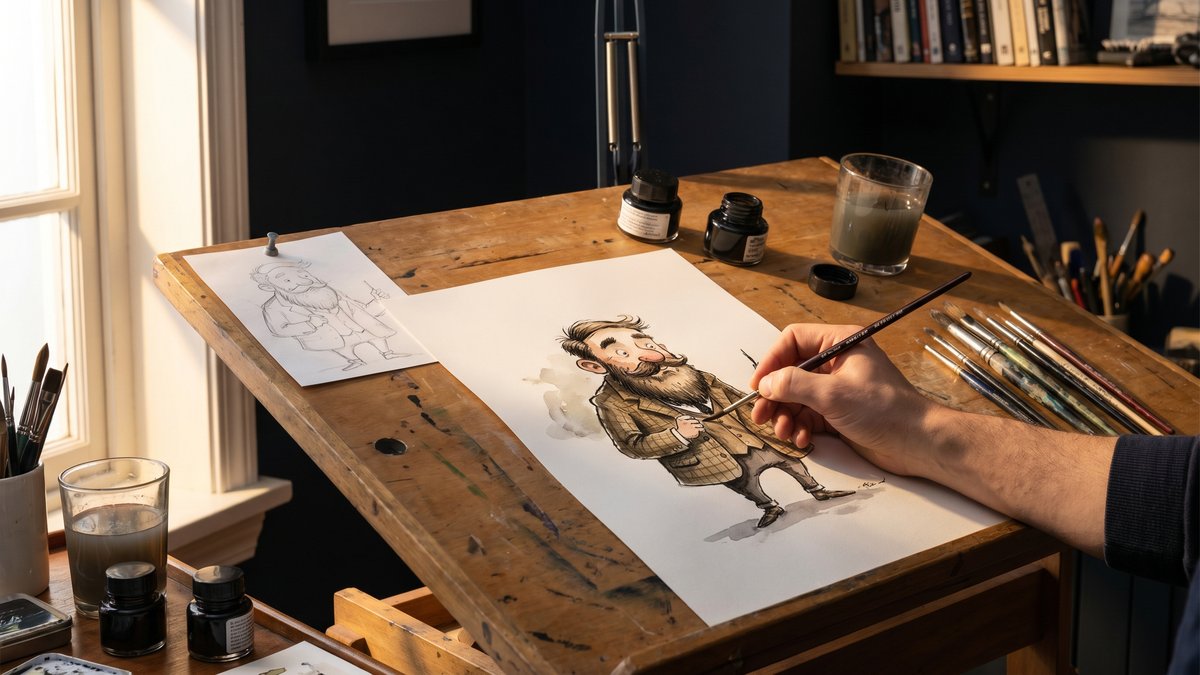
In 1995, one company became the exclusive publisher of more than half a million pieces of clip art. A freelance illustrator drew spot art for newsletters, brochures, and corporate decks. Now she was quoting against half a million pictures that cost almost nothing per use.
That library was the first tremor. Over the next fifteen years, three waves of cheap imagery reshaped commercial illustration from the bottom up. The illustrators who came through left the clearest survival map any visual creative can read in 2026.
It's a closer analog to AI image and video generation than the photographers' story. Illustration is invention from a blank page — the exact thing the new tools claim to do. What happened to illustrators between 2000 and 2010 is arriving now for video editors, animators, motion designers, and 3D artists. The illustrators went first. The map exists.
What the illustrator's living looked like in 2000
A working freelance illustrator in 2000 lived on commissions. A magazine needed a spot illustration for a feature. An ad agency needed a concept drawn. A company needed a brochure, an annual report, a set of icons, a mascot. Each job was commissioned, drawn by hand or in early digital tools, and paid as a one-off.
Most of that market was mid-tier and undifferentiated. A competent illustrator who turned a brief into a clean, on-message image competed on reliability and price. A smaller premium tier — the recognized names with a signature style — earned more, because clients wanted that specific hand.
The mid-tier was the bread and butter. It was also the first thing the libraries took.
The three waves
The disruption arrived in three waves, each one cheaper and broader than the last.
The first was clip art. Through the 1990s, libraries of pre-made images shipped on CD-ROMs and then bundled free into the software everyone already owned. Microsoft put clip art inside Office; by the time it shut the library down in 2014, it held well over a hundred thousand images. The illustrator who once drew a simple spot graphic for a fee was competing with a folder of free ones already installed on the client's computer.
The second wave was royalty-free stock. Getty Images, founded in 1995, and Corbis before it, built the licensing model that broke the old economics. Rights-managed licensing had priced an image by where and how long it ran. Royalty-free flipped that: pay once, use it almost anywhere, forever. For a buyer who needed a competent conceptual image, royalty-free stock was faster and cheaper than commissioning one.
The third wave was microstock, and it reached illustrators directly. iStockphoto, started in 2000 by a web developer named Bruce Livingstone, became the original source not just for cheap photos but for vectors and illustrations — drawn artwork, sold for a few dollars a file. Getty bought iStock in 2006, the same acquisition that reset the photographers' market. Illustrators could now upload work to those libraries, earn cents on a sale, and compete with thousands of others doing the same.
By the end of the decade, the libraries had absorbed the bulk of the low-to-mid commercial illustration market — the spot art, the corporate graphics, the generic conceptual images once commissioned one at a time. The mid-tier commission didn't vanish overnight. It was hollowed out and repriced, the same way the bulk tier was for the translators a few years later.
The pivot that didn't work
The most natural response was the one that failed slowly.
Illustrators competed with the libraries on the libraries' own terms. They joined the microstock sites as contributors, uploading work by the hundred, hoping volume would replace the commissions that had dried up. A file might sell for a few dollars, of which the contributor kept a fraction.
It was a trap with a trickle of income. The math only worked at enormous volume, and the supply kept getting cheaper as more illustrators piled in. The contributor was racing thousands of others to the bottom of a price the library set and kept lowering. It's the same dead end the writer meets by answering AI with cheaper, faster output — the race to the bottom no freelancer wins. A library of half a million files will always beat a human at cheap.
The pivots that worked
Three repositionings carried illustrators through with their rates intact or rising. Each one moved away from the commodity image and toward something a library couldn't stock.
The first was the editorial tier. As the mid-market commission fell away, the high end of editorial illustration held its value. A magazine cover, an op-ed illustration, a feature spread at a publication that competes on the quality of its art — these stayed commissioned and stayed premium. The illustrators who held that tier were recognized hands. At The New Yorker, the art desk commissions a regular stable — names like Christoph Niemann and Maira Kalman — whose work no library could supply, because the value is the artist's specific eye. The broad editorial market shrank as magazines closed. The top tier did not. It concentrated.
The second was the narrative specialty — illustration tied to a sustained story rather than a single image. Children's book illustration kept its commissioned, agent-represented model, paid on an advance against royalties, because a picture book is one artist's voice across thirty-two pages, not a stock image dropped into a layout. Comics went further: across the two decades that followed, the graphic novel grew from a niche into one of the best-selling categories in publishing. A library can sell you one image. It cannot sell you a world, a character held across two hundred pages, a story only one hand can carry. That work stayed human and grew.
The third was the named hand, and it's the one that matters most for 2026. As generic illustration commoditized, the illustrator with a recognizable, signature style became more valuable, not less. The clients who wanted that specific look couldn't get it from a library, by definition — a library exists to supply the interchangeable. The named hand was the opposite of interchangeable. A distinctive style turned the illustrator's name into the product, the one thing on the page a competitor couldn't download. The work shrank in volume and rose in standing, and the rate followed the name.
The structural lesson for 2026
The illustrator's three survivors are the same three the whole series keeps finding, drawn in a different medium.
The editorial tier is the judgment retainer: the seat where the work is hard, visible, and accountable, and the buyer pays for a specific human to own it. The narrative specialty is the human-crafted shelf — work whose value is continuity, voice, and authorship across a whole piece, not a single asset a tool can mint. The named hand is the human-crafted premium itself, the signature that can't be downloaded, the same asset that put the translator's name on the book cover.
Read the illustrators as a receipt. Their disruption ran a full cycle — flood, hollowing, repricing, and a premium tier that survived and rose. The pivots that held for a decade against the cheapest imagery the market had ever seen are the pivots forming now, one medium over.
The bridge to 2026
Here's where the illustrators stop being history and start being instructions.
The visual disciplines under AI pressure in 2026 are running the illustrators' decade at high speed. Image generation — Midjourney, DALL·E, and Stable Diffusion, all from 2022 — did to the static image in two years what clip art and stock took fifteen to do. Video generation is now doing it to motion: OpenAI's Sora, announced in 2024, Runway's Gen-2 and Gen-3, Google's Veo. Gaussian splatting and AI scene tools are doing it to 3D. The flood has arrived for the video editor, the animator, the motion designer, and the 3D artist, on the curve the illustrator already rode.
So read the survivors as your own. The video editor's editorial tier is the cut no model can sequence — the documentary, the brand film, the story whose pacing is a human judgment. The animator's narrative specialty is the character held across a film, not a generated clip. The motion designer's named hand is a signature motion language a client comes to you specifically to get. The 3D artist's premium is the world only that artist builds. Same pivots, new medium. The tool changed; the eye, the story, and the name did not.
The illustrators reached these positions over a decade, mostly alone, many after years lost on the microstock treadmill first. The disciplines facing the AI wave now have the whole map in advance — the one advantage no prior disruption handed its survivors.
The renaming, again
The illustrator who survived stopped calling herself an illustrator who took any job that came in. She named herself a children's book illustrator, an editorial illustrator, an artist with a style clients asked for by name. The skill was continuous with what she had always done. The name moved to where the value concentrated, before the rate could follow it.
The 2026 video editor, animator, and motion designer are being asked the same thing. The commodity tier of your medium is going to the machine, the way the commodity image went to the library. The premium tier — judgment, narrative, the named hand — is forming now, and it isn't yet crowded. The survivors of every prior wave were the ones who named themselves into the new category early, while the name was still available.
Working illustrators today report the same budget compression arriving a second time, now from AI. The pressure never fully stopped, and the premium tiers are still the ground worth standing on. The medium keeps changing. The map doesn't.
Where Haven AI fits
The renaming work — what to call the eye, the story, or the signature you bring once the machine floods the commodity tier of your medium — is the work Ariel was built for. The Socratic questions that move a creative from "I make images" or "I cut video" toward the specific, named, premium tier of their craft that no library and no model can stock.
The illustrators did it over a decade, by feel, mostly alone. The video editor, the animator, the motion designer, and the 3D artist can do it in dialogue, with the illustrators' whole map already in hand.
The flood is not the end of the medium. For the illustrators, it was the start of the part that paid.
In Haven AI's research across 8,300+ freelancer quotes, the illustrators' 2000-2010 disruption is the closest visual-medium analog to what AI image and video generation are doing now. The editorial tier, the narrative specialty, and the named hand are the receipts — and they map directly onto the 2026 video editor, animator, motion designer, and 3D artist.