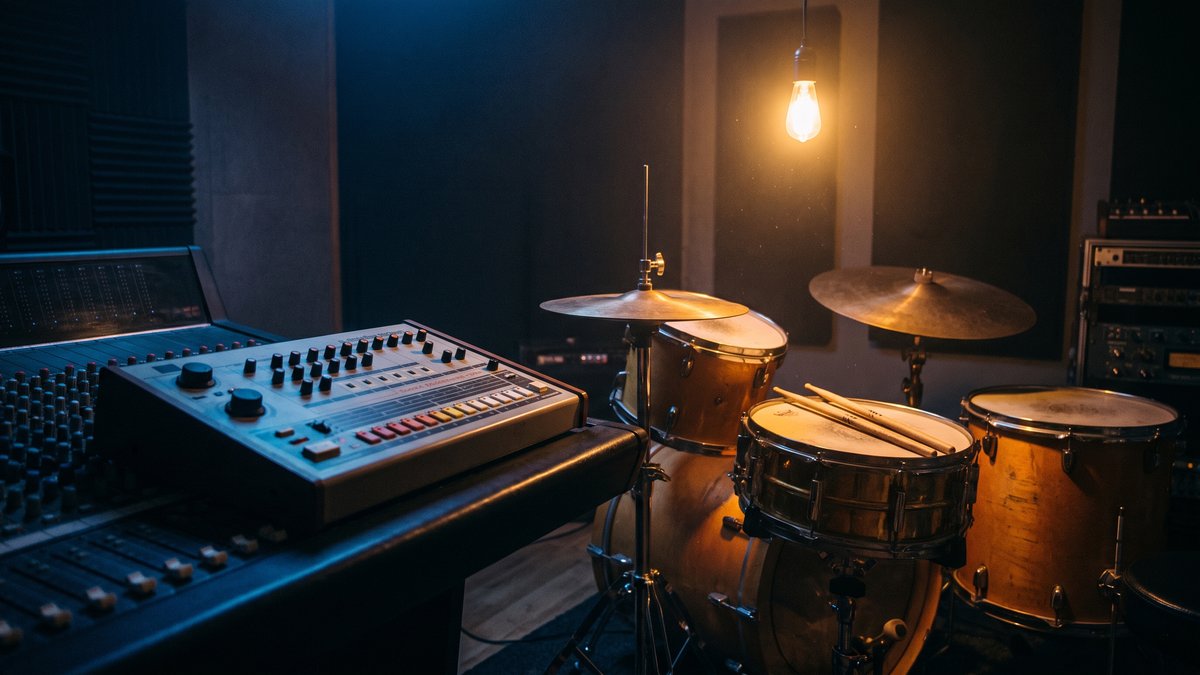
In 1980, a five-thousand-dollar box arrived in Los Angeles recording studios, and the city's session drummers had reason to be afraid.
The box was the Linn LM-1, the first drum machine built from recordings of real drums. It kept perfect time. It never tired, never needed a second take, and never charged for a session. The fear around it was specific and reasonable — that it would put every session drummer in Los Angeles out of work. It's the cleanest map a freelancer staring down AI can read, because of how it actually turned out.
The box that played for nothing
A session drummer's bread and butter was a steady, repeatable beat, recorded clean, on schedule. The LM-1 did exactly that, and it did it for the price of the machine instead of the price of a player.
Then the boxes got cheaper, fast. The LM-1 listed near $4,995 in 1980; only a few hundred were ever built. By 1983 the E-mu Drumulator arrived at $995 — the first sample-based drum machine under a thousand dollars. Inside three years the cost of a competent, tireless rhythm track fell by most of its value.
This is the part that rhymes with 2026. A machine showed up that did the measurable job — keep time, hit the grid, never complain — cheaper and faster than the trained human, and got cheaper every year. The producer who only needed a clean beat stopped booking a person to get one.
What it actually took
The displacement was real, and it reached the top of the trade. Hal Blaine was one of the most recorded drummers in history. From the 1980s on, he played less, as machines and electronics moved into the studios and producers brought in younger players.
The unions saw it and named it. In 1984 the American Federation of Musicians' president put the fear plainly on the evening news:
"They keep refining these devices to the point you can't tell the difference between the electronic device playing the instrumental part and the instrumental part being played by the live musician."
But honesty matters here, because the romantic version of this story is wrong. There's no clean figure for session jobs lost, and the music industry of the 1980s grew larger, not smaller. The machine didn't end the work. It changed what the work was — automating the commodity beat and leaving a harder question about what a human drummer was still for.
The thing the grid couldn't fake
The early machines had a tell. Everything landed exactly on the grid, perfectly quantized, and to a lot of ears it sounded wrong in a way that was hard to name.
The name is feel. A human drummer plays a fraction ahead of the beat or a fraction behind it, drops in ghost notes, leans the time in ways a metronome never does. That micro-timing is the difference between a beat you count and a beat that moves you. Researchers studying musical rhythm later put numbers to it — they found that "computer generated perfect beat patterns are frequently devalued by listeners due to a perceived lack of human touch."
The proof showed up in the machines themselves. Their makers started adding "swing" and "humanize" controls — features whose only job was to put human imperfection back into a grid that was too perfect to groove. The machine had to be taught to sound less like a machine.
The drummers who got more expensive
Here's the turn the fear didn't predict. The best session drummers didn't get wiped out. They got more valuable, because the one thing the machine couldn't fake was the one thing only they had.
Jeff Porcaro was, by wide agreement, the most highly regarded studio drummer in rock from the mid-1970s to the early 1990s. His half-time shuffle on Toto's "Rosanna" in 1982 — built from three older grooves and threaded with ghost notes — is still studied by drummers who could program any beat in seconds. His bandmate David Paich named what set him apart:
"Having grown up in a time before drum machines, I think he had the best time and groove of any drummer I've ever played with, but he also had the kick and power of a big band drummer."
Call it the feel premium. Once the machine took the commodity beat, the steady-time job stopped being the product. What buyers paid top rate for was the thing the grid couldn't manufacture — the human pocket, the groove, the choice to sit a hair behind the beat. The drummers who had it didn't compete with the box on price. They sold what it couldn't make.
And watch what those drummers did with the machine. Many of LA's top session players — Porcaro among them — bought the drum machines themselves and learned to program them. Instead of boycotting the thing that threatened them, they absorbed it — used it for the grid work and kept charging for the feel.
The man who built the machine agreed
The most telling verdict came from Roger Linn, the engineer who built the LM-1 — the man who, by one magazine's headline, had murdered the drummer.
He didn't see it that way, and he was specific about why. In his telling the machine ended up giving working drummers more work, not less, because it became another tool in their kit. And when the wrong hands used it, the limit showed:
"When someone who isn't a drummer programs the machine on a record … it sounds very repetitive, dull and lifeless."
The inventor of the disruption located the human's value exactly where the survivors did. The machine was a fine instrument and a poor musician. It could keep the time. It couldn't supply the feel, and a record without feel announced itself.
What this maps onto in 2026
AI is the drum machine. It does the measurable, repeatable job — clean copy, competent code, a passable layout — cheaply, instantly, on the grid, and it gets cheaper every quarter. The commodity beat is going to the box, the way it did in 1981.
The freelancer who answers it by out-producing the machine is the drummer trying to keep steadier time than a metronome. That contest is lost. The ones who come through do what the session players did — move the value to the feel: the judgment, the taste, the ahead-or-behind-the-beat human choices a client can't get from a clean grid. It's the same move the Swiss watchmakers made into the craft tier when quartz took the measurable job.
The illustrators lived the same turn when cheap images flooded their market — the survivors were the ones whose signature hand was the thing no library could stock. A style, like a groove, is a kind of feel.
There's a hard part the drummers lived too. The feel premium is a smaller tier. It holds rates, not headcount. Fewer seats, each worth more — and the steady-paycheck middle is the part the machine took. That's the real shape of the bind AI hands you: the path through doesn't restore the old volume of work. It offers a seat among the players paid for what the box can't play.
And there's the example worth copying. The survivors bought the machine. They let it carry the grid work and spent their human hours on the part that was theirs alone. Resisting the tool wasn't the move. Knowing which part of the job was the feel — and refusing to give that part away — was.
Where Haven AI fits
The work of finding your feel — the specific human judgment under what you make, the part a clean grid can't fake — is the work Ariel was built for. Not a faster way to hit the grid, but the Socratic questions that surface the groove only you play, so you can move the value there before the rate for the beat collapses.
A drum machine keeps better time than any human alive. Forty years of records say the time was never what the great drummers were selling.
In Haven AI's research across 8,300+ freelancer quotes, the feel premium is the survival pattern that recurs through every machine-age disruption — when a cheap tool wins the measurable job, the human value moves to what the tool can't fake. For the session drummer it was the pocket; for the 2026 freelancer it's the judgment and taste under the work. The tier is smaller and it pays more, and the players who made it bought the machine instead of fighting it.